
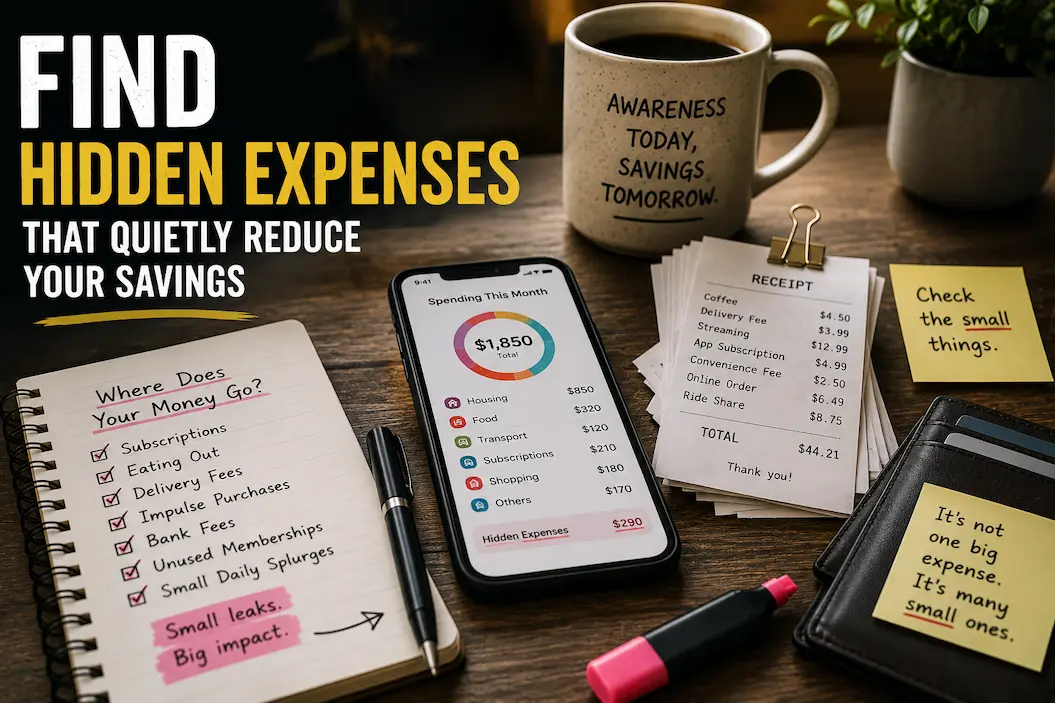

People looking to save money often say it’s simple: earn cash, pay bills, live within your means, and save the difference. In reality, however, the problem usually isn’t that any single expense is excessively high. Money often slips away unnoticed through small, random, easily forgotten, or barely perceptible expenses—costs that seem insignificant on their own and are therefore frequently overlooked.
Factors that can make saving more difficult include rarely used subscriptions, creeping energy costs, delivery fees or convenience charges for low-cost items, recurring services, and annual renewals. Avoiding these expenses doesn’t mean you are irresponsible with money; the issue is that they can remain hidden long enough to be mistaken for standard, necessary costs. Identifying these hidden expenses doesn’t mean giving up life’s pleasures. The key is to gain insight into the true cost of your lifestyle. Find out where that “forgotten” money is going. This helps you determine which bills are worth keeping and which ones are actually hindering your savings goals.
Start With Where Your Money Actually Goes
Don’t rely on your memory alone. While most people can easily recall their monthly bills, remembering the details of smaller transactions is much harder. A few minor purchases during a busy week may seem trivial, but they can add up to a significant amount by the end of the month.
Review your recent bank and credit card transactions—at the very least, those from the past month. If your monthly spending fluctuates significantly, it is more accurate to review data covering two to three months. Don’t make assumptions about every single transaction. The first step is to list the expenses you typically overlook when budgeting. When reviewing your transaction history, look out for automatic debits, infrequent charges, unusually high amounts, duplicate charges, or debits linked to other expenses. These categories often represent expenses that show up on your bank statement but you frequently overlook in your day-to-day life.
Separate Necessary Costs From Overlooked Costs
An expense can be necessary and still be worth investigating. For example, electricity is a legitimate household expense, but an unexpectedly high bill may deserve attention. Insurance may be necessary, but a renewal or changed premium can affect the amount available for savings. A bank account may be useful, while an avoidable fee attached to it may not be.
This distinction matters because the objective is not to label every non-essential purchase as wasteful. A useful hidden-expense review asks a more specific question: “Is this cost still worth what I am paying for it?”
That question produces better decisions than simply asking whether something is cheap or expensive.
Look for Recurring Charges You No Longer Notice
Recurring payments are among the easiest expenses to overlook because they happen without requiring a new spending decision. Once a subscription or membership is connected to automatic billing, it can continue for months even if your interest in the service has declined.
Check your statements for streaming services, cloud storage, software, memberships, apps, delivery programs, digital publications, gaming services, and other recurring charges. Do not limit the search to monthly payments. Some services bill quarterly or annually, making them much easier to forget. A useful approach is to create a simple recurring-payment list with four columns:
| Expense | Frequency | Approximate annual cost | Still worth it? |
|---|---|---|---|
| Streaming service | Monthly | €120 | Yes |
| Cloud storage | Monthly | €36 | Maybe |
| Gym membership | Monthly | €420 | No |
| Software subscription | Annual | €84 | Yes |
The annual figure can be especially revealing. A payment that looks insignificant at €7 per month becomes €84 when viewed over a full year. That does not automatically make it a bad expense, but it gives you a better basis for deciding whether the service deserves its place in your budget.
Check for Duplicate Services
Another hidden expense occurs when you pay for two services that perform largely the same job. This can happen gradually. You might subscribe to one cloud-storage provider and later receive additional storage through another service. You might pay for multiple entertainment platforms even though you regularly use only one or two. A household could also maintain separate memberships that provide overlapping benefits.
Duplicate spending is particularly easy to miss when each individual charge appears reasonable. Instead of asking whether each service is affordable, compare them by function. Group similar expenses together and ask whether you actually need all of them.
For example, if three subscriptions provide similar entertainment value but you regularly use only one, the question is not whether the other two are expensive. The question is whether they are contributing enough value to justify their combined cost.
Search for Fees Attached to Ordinary Spending
Some expenses are not separate purchases at all. They are extra charges attached to purchases you were already planning to make. Delivery charges, service fees, convenience fees, payment-related charges, account fees, and small transaction costs can hide inside otherwise ordinary spending. Because these amounts often appear alongside the main purchase, you may not see them as independent expenses.
Review several recent receipts and compare the advertised or expected price with the amount that actually left your account. This can reveal patterns that are difficult to see from a bank statement alone.
You may discover, for example, that frequent small delivery charges are adding a meaningful amount to your monthly spending. The solution does not necessarily have to be eliminating delivery altogether. It could be combining orders, choosing pickup when practical, changing the frequency of purchases, or deciding that the convenience is worth paying for only on certain occasions. The important part is knowing what the convenience actually costs you.
Pay Attention to Small “Convenience” Spending
Convenience spending can be difficult to classify because it is not necessarily bad spending. Sometimes paying more saves time, reduces stress, or solves a genuine problem. The hidden issue is frequency.
A €4 convenience purchase may feel irrelevant when it happens once. If similar decisions occur several times each week, however, the monthly total can become much larger than expected.
Look for patterns such as:
- Frequent delivery instead of pickup
- Paying extra for last-minute purchases
- Buying individual items because planning was delayed
- Repeated convenience-store purchases
- Small digital purchases made without much thought
- Paying for premium versions of services you rarely use
- Replacing forgotten household items through urgent purchases
Rather than banning these expenses, calculate their frequency. A small cost repeated often is usually more important to investigate than an occasional larger purchase that you consciously planned.
Review Annual and Irregular Expenses
Monthly budgets can create a false sense of accuracy because many real expenses do not arrive every month.
Insurance renewals, memberships, software licenses, vehicle-related costs, professional fees, school expenses, gifts, travel, home maintenance, and seasonal spending may appear only once or a few times each year. If you do not consider these costs in advance, they can suddenly consume money that you intended for savings. Make a list of expenses that occur less frequently than monthly. Then estimate their annual cost and divide that amount by twelve.
For example, suppose several irregular expenses add up to €1,200 over a year:
€1,200 ÷ 12 = €100 per month
That does not mean you must literally pay €100 every month. It means that treating the expense as a €100 monthly planning requirement can prevent it from unexpectedly competing with your savings when the bill arrives. This is one of the best ways to uncover expenses that feel “unexpected” even though they happen every year.
Compare Your Bills With Earlier Bills
Hidden expenses can also appear as gradual increases rather than new charges. A service may increase its price. An insurance premium may change. A utility bill may rise because your usage or rates changed. You may find that your mobile plan includes features you no longer need. Because the increase happens gradually, it may not attract much attention.
Choose several important recurring bills and compare a recent statement with one from six or twelve months earlier. You do not need to investigate every small fluctuation. Focus on changes that are persistent or large enough to affect your monthly cash flow.
If a recurring bill has increased, identify why before deciding what to do. Sometimes the higher cost reflects increased usage or a necessary change. In other cases, you may be able to change the plan, reduce usage, remove an unused feature, or compare available alternatives.
Watch for “Forgotten” Spending
Some hidden expenses are not automatic at all. They are simply expenses that have become so routine that you stop thinking about them. This could include buying the same item every time you shop, routinely adding something small to an online order, paying for a service because you have always used it, or making a regular purchase at a particular time of day.
These transactions are easy to miss because they do not feel like decisions anymore.
One useful test is to examine repeated transactions and ask:
“If I saw this charge for the first time today, would I still choose it?”
If the answer is yes, keep it without guilt. If the answer is no, investigate why it continues. The purpose of the question is not to create guilt around spending. It is to interrupt autopilot.
Calculate What the Hidden Expense Is Costing Your Savings Goal
Once you find an overlooked expense, connect it to something meaningful rather than simply calling it “waste.”
Suppose you discover that several unnecessary recurring charges and convenience expenses total €65 per month.
Over a year:
€65 × 12 = €780
If you redirect that amount toward a savings goal, the decision becomes easier to evaluate. You are not merely “cutting €65.” You are potentially freeing €780 per year for an emergency reserve, a planned purchase, debt repayment, or another financial priority. The calculation also works in the opposite direction. If an expense genuinely provides substantial value, you can keep it knowing exactly what it costs. This prevents the hidden-expense exercise from becoming an exercise in cutting everything possible.
Use a Hidden-Expense Audit Instead of a Permanent Spending Ban
A useful hidden-expense review can be completed periodically rather than turning into another complicated financial routine.
Once a month or once every few months, review:
- Recurring subscriptions and memberships
- Bank and account fees
- Delivery and service charges
- Recent price increases
- Duplicate services
- Annual and irregular expenses
- Repeated convenience purchases
- Digital purchases and app charges
- Household bills that have changed
- Expenses you no longer remember actively choosing
Mark each item as keep, reduce, replace, pause, or cancel.
The “keep” category is important. Not every expense needs to be eliminated simply because it is not essential. A service that you use regularly and genuinely value can remain in the budget. The goal is to remove expenses that no longer earn their place, not to create the smallest possible lifestyle.
Give the Money You Free a Specific Job
Finding hidden expenses is only half the process. If the money you free simply becomes available for other unplanned spending, your savings may not improve. Before you cancel or reduce an expense, decide where to direct the money you free up. You might increase an existing automatic savings transfer, build a fund for an upcoming purchase, strengthen a cash reserve, or direct the money toward another financial priority.
For example, if cancelling unused subscriptions frees €30 per month, setting up an automatic €30 transfer can turn an invisible spending reduction into a visible savings habit.
This creates a simple connection:
Hidden expense → money freed → specific savings goal
The clearer that connection is, the easier it becomes to see whether your changes are actually improving your financial position.
What Not to Cut Just Because It Appears on a Statement
A hidden-expense audit can become counterproductive if every expense is treated as suspicious. Some costs provide real value even when they are not strictly necessary. Paying for convenience, entertainment, hobbies, professional tools, or services that save meaningful time can be reasonable if they fit your financial priorities.
You should also be careful about cutting costs that could create larger expenses later. For example, skipping necessary maintenance, adequate insurance, important professional services, or other legitimate obligations simply to increase short-term savings may not be a sensible trade-off.
The better question is not “Can I eliminate this?”
It is “Does this expense deserve the money it currently receives?”
That question leaves room for both financial discipline and a realistic quality of life.
A Simple Monthly Hidden-Expense Check
You do not need a complicated spreadsheet to keep these expenses under control. Once a month, spend a short amount of time reviewing your transactions and recurring payments.
Look for anything that is:
- Repeated but rarely noticed
- More expensive than it used to be
- Charged automatically
- Used less than expected
- Duplicating another service
- Associated with frequent convenience spending
- Occurring annually rather than monthly
- No longer connected to a current priority
Then choose only a few changes. Cancelling ten services at once is unnecessary if three obvious decisions can produce most of the improvement.
After making the changes, monitor the next few months. The purpose is not to perform a perfect financial cleanup once. It is to make sure old spending does not quietly return and new recurring expenses do not accumulate unnoticed.
Conclusion
Hidden expenses rarely ruin your savings plan through a single large transaction. They often operate unnoticed: forgotten subscriptions, fixed monthly costs, subtle price hikes, and small, convenient purchases that gradually become habits.
The solution is to first map out your spending and then consider ways to cut back. Carefully review your actual transaction history, identify recurring and irregular expenses, examine costs and ongoing services, compare changes in your bills, and calculate the total amount of overlooked spending over the course of a year. Then, decide which expenses are truly worth keeping.
You don’t have to give up everything you enjoy spending money on to save. Often, the most valuable opportunities for saving are hidden in expenses you no longer actively monitor. Once these expenses come to light, you can make conscious choices and specifically allocate the savings to your savings plan.
FAQs
1. How often should I check for hidden expenses?
Monthly checks are useful because they allow you to spot recurring expenses and recent changes early on, preventing them from becoming ingrained habits. Conducting a more thorough review of your bills every few months helps you identify annual subscriptions, irregular expenses, and creeping costs that might not appear in the current month’s transaction summary.
2. Are small expenses really worth monitoring?
Yes, but the frequency matters more than the amount itself. A single small expense may have little impact on your finances, whereas a small, recurring fee can add up significantly over the course of a year. Instead of assuming that every small expense needs to be cancelled, it is better to search for recurring patterns.
3. Should I cancel all subscriptions I rarely use?
Not necessarily. If a subscription offers enough value to justify the cost, keeping it is a reasonable option. The goal of reviewing subscriptions is to identify services you pay for but do not use or find valuable—not to cancel them simply because some subscriptions are optional.
4. How should I handle the money I save by cutting out hidden expenses?
Assign it a specific purpose. You could increase your automatic savings, fund planned purchases, top up your emergency fund, or use it for other important financial matters. By earmarking money for a specific goal, you reduce the likelihood of it being spent on other things.

Ethan Walker is a personal finance writer who focuses on helping beginners understand money simply and practically. He writes about budgeting, saving money, financial literacy, and side hustles with the goal of making financial education easier and more approachable. His content is designed to help readers build better financial habits and make smarter everyday money decisions.