
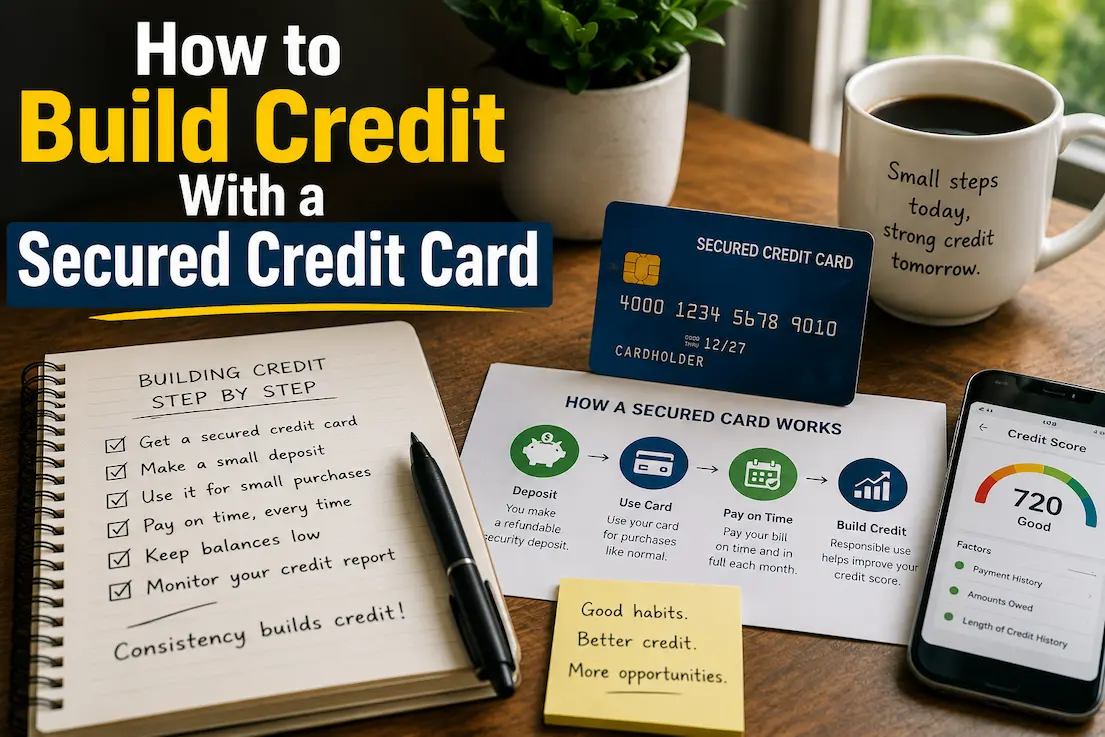

A secured credit card can be a useful starting point for someone who has little credit history or is trying to rebuild a damaged one. Unlike a traditional unsecured credit card, a secured card usually requires a refundable cash deposit that helps protect the card issuer if the account is not repaid as agreed.
The deposit does not normally become your spending balance. Instead, it typically serves as security for the account while you use the card much like a regular credit card. If the issuer reports the account to the major credit reporting companies, your payment activity can become part of your credit history.
That distinction is important. Simply opening a secured card does not guarantee that your credit score will improve. The potential benefit comes from using an account that reports to the credit reporting companies and then managing it responsibly over time. Payment history, amounts owed, length of credit history, new credit, and credit mix can all play a role in FICO Scores, although the importance of individual factors varies by credit profile. (myfico.com)
What Is a Secured Credit Card?
A secured credit card is a credit card backed by a cash security deposit.
When you apply, the card issuer may require you to provide a deposit before the account is opened. The deposit is generally held as security rather than functioning like money loaded onto a prepaid card.
You then receive a credit limit according to the issuer’s terms. With many secured cards, the credit limit is related to the amount of the security deposit, although the exact relationship varies by issuer.
You use the card for purchases and receive statements just as you would with other credit cards. You are responsible for making at least the required payment by the due date, and interest can apply if you carry a balance under the card’s terms.
The CFPB describes secured credit cards as cards that require a cash deposit that typically serves as collateral for the credit line. (consumerfinance.gov)
How the Security Deposit Works
The security deposit is one of the main differences between a secured and unsecured credit card.
Suppose a card issuer requires a $300 security deposit and provides a $300 credit limit. You can use the card for purchases up to the available credit limit, subject to the account’s terms and available credit.
The $300 deposit does not mean you have already paid for your purchases. If you spend $100, you still owe the card issuer $100 according to the statement terms.
This is why a secured credit card should not be confused with a prepaid card.
| Secured credit card | Prepaid card |
|---|---|
| Requires a security deposit | Usually funded with money you load onto the card |
| Provides a credit line | Generally uses your prepaid balance |
| Purchases create a credit-card balance | Purchases generally reduce the prepaid balance |
| You make payments on the credit account | You generally do not make monthly credit-card payments |
| May help establish credit if reported | Generally does not build traditional credit history |
The exact deposit, credit limit, fees, and refund conditions vary by card issuer, so always read the account agreement before applying.
Check Whether the Card Reports Your Payments
This is one of the most important things to verify.
A secured card is useful for credit building only if the activity is reported in a way that can become part of your credit history. Before applying, check whether the issuer reports the account and payment history to the major nationwide credit reporting companies.
Do not assume that every financial product advertised as a “credit-building” card works in exactly the same way.
The CFPB recommends asking whether a secured card reports to the three major credit reporting companies before applying. (consumerfinance.gov)
You should also check whether the issuer reports positive and negative payment information. An account that is reported can potentially help establish a record of responsible management, but missed payments can also become part of your credit history.
Why Payment History Matters
Once you have the card, the most important habit is making payments on time.
Payment history is a major component of FICO scoring. FICO identifies it as the largest general category in its commonly used scoring framework, accounting for 35% of the calculation, although an individual’s actual score depends on the complete credit profile and the scoring model being used. (myfico.com)
A secured card therefore works best when you treat it as a tool for establishing a predictable payment record rather than as extra spending money.
Set a reminder for the due date. If automatic payments are appropriate for you, consider arranging one for at least the required payment while continuing to monitor your account.
Most importantly, make sure you have enough money available when the payment is scheduled.
You Do Not Need to Carry a Balance
Carrying a credit-card balance from one month to another is not a requirement for building credit.
If your finances allow it, you can use the card for purchases and pay the statement balance in full by the due date. Depending on the card’s terms, doing so can help you avoid interest charges on purchases while still allowing the account’s activity to be reported.
The CFPB specifically states that consumers do not need to carry a balance on a credit card to build a good credit score. (consumerfinance.gov)
This is an important distinction because paying interest does not make a payment history more valuable simply because interest was charged.
The purpose of a secured card is to demonstrate responsible credit management, not to create interest expenses that you could otherwise avoid.
Keep Your Spending Well Within the Limit
Credit utilization is another factor that can affect many credit scores.
Credit utilization refers broadly to how much of your available revolving credit you are using. If a card has a $500 limit and a $100 balance, the utilization would be 20%.
A high balance relative to the credit limit can be a concern, particularly when you consistently report it. FICO identifies amounts owed as another major category in its scoring framework and considers revolving utilization as part of that broader category. (myfico.com)
There is no universal rule that everyone must keep their utilization below a particular percentage to have good credit. However, keeping balances manageable is sensible for both credit management and household budgeting.
If your secured card has a relatively small limit, even ordinary purchases can take up a large percentage of that limit. You therefore may need to keep spending modest or make payments during the billing cycle when appropriate.
A Small Credit Limit Is Not Necessarily a Problem
New users sometimes become frustrated when a secured card starts with a low credit limit.
A small limit can actually make the account easier to control.
For example, if you have a $300 limit, you could use the card for a few predictable expenses rather than treating it as a general-purpose spending account. You might use it for a recurring bill or several routine purchases that already fit comfortably within your monthly budget.
The goal is not to spend close to the limit.
The goal is to create a manageable pattern in which purchases are made, statements are reviewed, and payments are made on time.
Over time, the issuer may review the account and potentially increase the credit line or transition the account to an unsecured card, depending on its policies. This is not guaranteed, so do not choose a card based solely on the expectation that an upgrade will occur.
Choose the Card Based on More Than the Deposit
A low deposit requirement can look attractive, but it should not be the only factor you consider.
Before applying, compare the overall terms.
| What to check | Why it matters |
|---|---|
| Security deposit | Determines how much of your cash will be tied up |
| Credit limit | Determines how much available credit you receive |
| Annual fee | Adds an ongoing cost to the account |
| Interest rate | Matters if you carry a balance |
| Reporting practices | Determines whether account activity can contribute to your credit history |
| Late-payment terms | Important if you miss a payment |
| Foreign transaction fees | Relevant if you make purchases abroad |
| Upgrade policy | May indicate whether the issuer reviews accounts for unsecured status |
| Deposit refund conditions | Explains when and how your security deposit may be returned |
A card with a slightly higher deposit requirement may still be less expensive over time if it has better terms. Conversely, a card with a low initial deposit may become costly if it carries substantial fees.
Look at the complete agreement rather than choosing based on an advertisement.
Understand the Difference Between the Deposit and Your Payment
Another common misunderstanding is thinking that the security deposit can be used to pay the monthly bill.
Generally, that is not how a secured credit card works.
If you deposit $500 and receive a $500 credit limit, spending $200 does not automatically deduct $200 from the deposit. You still owe the card issuer for the $200 purchase.
The deposit exists as security for the issuer.
If the account is closed under circumstances where the deposit is refundable, the issuer’s handling of the deposit will depend on the account agreement and whether you have outstanding obligations. The deposit may not be returned immediately if there is a remaining balance or another amount owed.
Read the issuer’s deposit and account-closure terms carefully so you know what to expect.
Use the Card for Purchases You Could Already Afford
One of the safest ways to use a secured card is to treat it as a payment method for expenses already included in your budget.
For example, suppose your monthly budget already includes $80 for household purchases. You could place some of those purchases on the secured card and set aside the money needed to pay the resulting statement.
This approach keeps the credit-building activity connected to spending you were already planning to do.
It also reduces the temptation to view the credit limit as additional income.
A credit limit is borrowed purchasing capacity. It is not a raise, emergency fund, or source of free money.
What Happens If You Miss a Payment?
Missing a payment can undermine the purpose of opening a secured card.
Depending on the circumstances, a late payment can lead to fees, interest charges, and potentially negative information being reported to the credit reporting companies. The consequences depend on the account agreement and how late the payment becomes.
If you realize that you may not be able to make a payment, contact the card issuer as soon as possible rather than ignoring the account.
If you are building credit from scratch, protecting your payment record should be a priority. A secured card can help establish positive credit history, but it can also create negative history if it is not managed responsibly.
Do Not Apply for Several Secured Cards at Once
You generally do not need several secured cards to begin building credit.
Opening multiple accounts may create additional applications and new-account activity. FICO considers recent credit activity as part of its scoring system, and opening several accounts in a short period can be more significant for people with limited credit histories. (myfico.com)
Instead, spend time comparing cards before applying.
One suitable account that you can comfortably manage may be more useful than several accounts that divide your attention and increase the number of payments and fees you need to monitor.
Monitor Your Credit Reports
Opening a secured card should not mean forgetting about your credit reports.
Reviewing your reports periodically can help you confirm that the account information is accurate. It can also help you spot accounts or activity that you do not recognize.
For U.S. consumers, AnnualCreditReport.com is the federally authorized source for obtaining credit reports from Equifax, Experian, and TransUnion. (annualcreditreport.com)
If you notice inaccurate information, you can dispute errors with the appropriate credit reporting company and, when appropriate, the company that supplied the information.
You do not need to pay a third-party company simply to obtain your federally available credit reports.
When Can the Security Deposit Be Returned?
The deposit is generally refundable, but the timing and conditions depend on the card issuer.
If the account is closed in good standing, the issuer may return the deposit after outstanding balances and other obligations have been settled. Some issuers may also review accounts for possible conversion to an unsecured card and return the deposit if the account is upgraded.
Neither outcome should be assumed.
Before applying, read the issuer’s explanation of how and when the deposit can be released. Also remember that closing a credit card can affect the credit profile in different ways depending on the rest of your accounts and the scoring model being used.
If the account is still useful and affordable, there may be no reason to close it immediately simply because you have established some credit history.
How Long Does It Take to Build Credit?
There is no guaranteed timetable for reaching a particular credit score.
Credit information has to be reported and accumulated over time, and different scoring models use different calculations. Your starting credit profile, payment history, balances, account age, and other information all matter.
FICO explains that a valid FICO Score generally requires at least one account that has been open for six months or more and at least one account that has been reported within the previous six months. That is a scoring-model requirement, not a promise that everyone will receive a particular score after six months. (myfico.com)
For that reason, be cautious about advertisements promising a specific number of points within a fixed number of days or months.
A better goal is to establish a record of responsible behavior and allow that history to develop naturally.
A Simple Routine for Using a Secured Card
You do not need a complicated system to manage the account.
A straightforward routine can look like this:
Before using the card:
Make sure the purchase fits within your existing budget.
During the month:
Keep track of the balance so that spending does not get ahead of your ability to repay it.
When the statement arrives:
Review every transaction and check the amount due and due date.
Before the due date:
Make at least the required payment. If possible and appropriate for your budget, pay the statement balance in full.
Each month:
Check the account for unexpected fees, transactions, or changes to its terms.
Periodically:
Review your credit reports and confirm that the account information is accurate.
This routine is deliberately simple. Credit building is more about consistency than finding a complicated trick.
Mistakes That Can Defeat the Purpose of a Secured Card
A secured card can be useful, but it does not remove the risks that come with borrowing.
Spending because the limit is available
A $500 credit limit does not mean you have $500 of extra income. Spend only what your budget can support.
Carrying a balance to “build credit”
You do not need to pay interest to establish responsible credit behavior. If your finances allow it, paying the statement balance in full can avoid unnecessary interest on purchases.
Ignoring the annual fee
A card may require a security deposit and still charge an annual fee. Compare the complete cost before applying.
Assuming the deposit pays your bill
The security deposit normally serves as collateral. It is not a substitute for making your required monthly payments.
Assuming every secured card reports everywhere
Reporting practices vary. Verify the issuer’s reporting policy before applying.
Chasing a particular credit-score number
Credit scores can change for many reasons, and different scoring models produce different results. Focus on the underlying habits rather than a promised score.
Is a Secured Credit Card Right for You?
A secured credit card can make sense when you want to establish or rebuild credit, have enough cash for the required deposit, and can comfortably manage monthly payments.
It may be less suitable if the deposit would consume money you need for essential expenses or if you are already struggling to keep up with existing financial obligations.
It is also worth considering whether another credit-building option would better fit your circumstances. A credit-builder loan, for example, works differently and may be appropriate for some people. There is no single product that is best for everyone.
The important question is not simply, “Will this card build my credit?”
A better set of questions is:
- Does the issuer report the account to the major credit reporting companies?
- Can I afford the deposit without weakening my emergency savings?
- Can I comfortably pay the bill on time?
- What fees will I pay?
- What interest rate applies if I carry a balance?
- What are the rules for getting my deposit back?
- Is there a realistic path to an unsecured card if that is important to me?
Building Credit Without Creating New Financial Problems
A secured credit card can provide a practical entry point into the U.S. credit system, particularly for people who have limited credit history. Its value comes from the opportunity to establish a reported record of responsible credit management—not from the security deposit itself and not from paying interest.
The strongest approach is straightforward: choose a card with reasonable terms, confirm that the issuer reports the account, use the card for purchases that fit your budget, make payments on time, and monitor your credit reports for accuracy.
There is no need to spend unnecessarily, carry a balance just to build credit, or apply for several cards at once. A secured card should support your financial goals rather than become another source of financial pressure.
Over time, consistent management can help create the credit history that lenders may consider when evaluating future applications. The exact effect on your credit score will depend on your individual credit file and the scoring model being used, so the most useful goal is not a particular score by a particular date. It is building a reliable record of responsible financial behavior.
This article provides general financial education about secured credit cards in the United States. Credit-card terms, fees, reporting practices, eligibility requirements, and issuer policies vary. Review the current card agreement and pricing information before applying, and consider your own budget and financial circumstances before taking on new credit.

Ethan Walker is a personal finance writer who focuses on helping beginners understand money simply and practically. He writes about budgeting, saving money, financial literacy, and side hustles with the goal of making financial education easier and more approachable. His content is designed to help readers build better financial habits and make smarter everyday money decisions.