
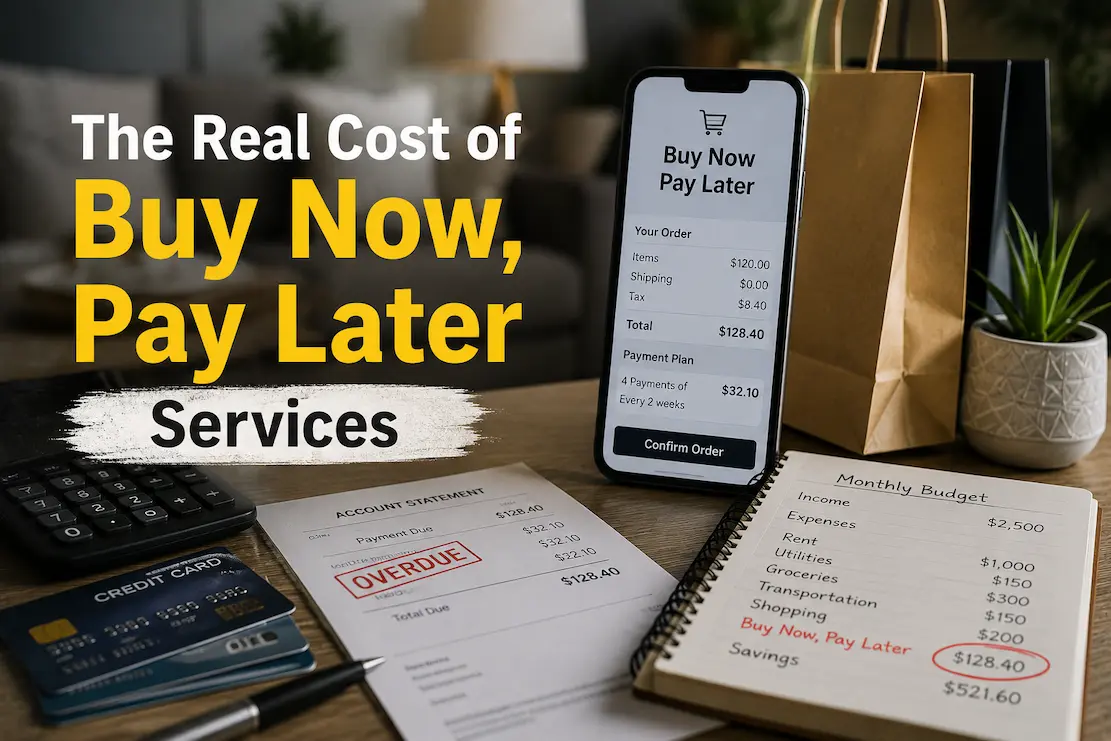

Buy Now, Pay Later (BNPL) services can make an expensive purchase feel surprisingly manageable. Instead of paying $400 at checkout, you might see an option to split the purchase into several smaller payments. The first payment may be due immediately, with the remaining payments spread over the following weeks or months.
That convenience is the main reason BNPL can be appealing. But the size of each payment can also make it easy to overlook the total financial commitment. A purchase that feels affordable at $50 every two weeks can still be a $200 purchase, and that payment may arrive alongside several other BNPL installments already scheduled.
Many BNPL plans advertise little or no interest, but that does not mean every plan is free or risk-free. Depending on the provider and product, there can be late fees, returned-payment fees, other charges, credit-reporting consequences, and problems when a purchase is returned or disputed. The real cost is therefore not just the price displayed at checkout. It is the combination of the purchase price, financing terms, fees, payment schedule, and effect on your overall budget.
What Buy Now, Pay Later Actually Does
A typical BNPL transaction allows you to receive an item immediately while paying the BNPL provider over time. In a common pay-in-four arrangement, the purchase is divided into four payments, although some products use different numbers of installments or repayment periods. The provider generally pays the merchant, while you make your scheduled payments to the BNPL company.
This arrangement can be useful when someone has enough income to comfortably handle the payments but prefers to spread a purchase across several paydays.
The important word is comfortably.
Being offered a payment plan does not mean the purchase fits your budget. A provider’s approval decision answers whether you can use that particular financing product under its criteria. It does not determine whether adding another payment is sensible for your household finances.
“No Interest” Does Not Always Mean “No Cost”
The phrase “0% interest” is one of the biggest reasons BNPL can look cheaper than traditional borrowing.
In a genuine interest-free pay-in-four arrangement, you may not pay interest on the purchase. But the absence of interest does not automatically eliminate every possible cost. The CFPB notes that BNPL products can charge late fees, while other fees can also apply depending on the provider and product. A bank may separately charge an overdraft or nonsufficient-funds fee if an automatic payment is attempted when there is not enough money in the account.
That means the advertised price and the potential cost are two different things.
Consider a $300 purchase. If the plan is genuinely interest-free and you make every payment on time, you might pay exactly $300. But if a late payment triggers a fee, or an automatic withdrawal causes a bank fee, the transaction can cost more than the original purchase price.
The lesson is simple: look beyond the interest rate.
The Payment Amount Can Hide the Size of the Purchase
BNPL changes how a price is presented.
A shopper might hesitate before spending $400 on a pair of headphones, appliance, piece of furniture, or clothing. But seeing “4 payments of $100” can make the same purchase feel much smaller.
Mathematically, nothing changed.
You are still committing to $400.
This matters because payment-based thinking can make several purchases appear affordable at the same time. One $50 payment may not seem significant. Five different purchases with $50 installments can create $250 of scheduled payments, and those obligations may overlap for several weeks.
The problem is not that installment payments are inherently bad. The problem is that small individual payments can hide the combined amount of your commitments.
The Real Cost Includes Your Future Cash Flow
Imagine that you earn $3,000 a month after taxes and have already committed most of it to rent, utilities, food, transportation, savings, insurance, and other expenses.
You see a $240 item and choose a four-payment plan of $60.
At checkout, $60 may look manageable.
But the relevant question is not whether you have $60 today. It is whether you have room for the remaining $180 after your other bills and obligations arrive.
This scenario is where BNPL can become a budgeting problem even when no interest is charged.
| What you see at checkout | What you should actually consider |
|---|---|
| $60 today | Can I comfortably pay today? |
| $60 every two weeks | What other bills are due during those weeks? |
| $240 total | Would I buy this if I had to pay the full amount today? |
| 0% interest | Are there late or other fees? |
| Fast approval | Does this purchase fit my existing budget? |
The right comparison is therefore not “Can I afford the installment?”
It is “Can I afford the purchase without putting pressure on money I already need for something else?”
BNPL Can Become More Expensive When Payments Are Missed
Missing a payment is one of the clearest ways a seemingly inexpensive BNPL transaction can become more costly.
The CFPB says many BNPL companies charge late fees when payments are not made on time. Depending on the provider, missed payments can also lead to the account being frozen, the debt being sent to collections, or payment information being reported to credit reporting companies.
The exact consequences depend on the agreement.
That distinction matters because there is no single universal BNPL contract. One provider may have different late-fee rules from another. One product may report certain information to credit bureaus while another may not.
Before accepting a plan, check the actual terms rather than assuming that every BNPL service operates the same way.
Your Bank Account Can Be Part of the Cost
Automatic payments are convenient, but they also create another risk.
If your BNPL provider automatically takes a payment from a debit card or bank account and there is not enough money available, your bank could potentially charge an overdraft or nonsufficient-funds fee. The BNPL provider may also impose its own applicable fee or other consequence.
This creates a cost that may not be obvious when you first choose the installment plan.
For example, imagine that you have $75 available in your checking account and a $60 BNPL payment scheduled. You may think you are safe because $75 is greater than $60. But if your rent, utility bill, or another automatic payment is processed first, the BNPL withdrawal could arrive when the balance is no longer sufficient.
Automatic payments should therefore be treated as real financial commitments, not background transactions that can be ignored.
BNPL and Your Credit Score Are More Complicated Than “Yes” or “No”
One common assumption is that using BNPL automatically helps or hurts your credit.
The reality is more complicated.
The CFPB has reported that many pay-in-four BNPL lenders historically have not reported these loans to the major nationwide credit reporting companies. As a result, successfully repaying a typical pay-in-four loan may not necessarily build your traditional credit history.
At the same time, problems can arise from failing to repay a BNPL obligation. The CFPB notes that unpaid BNPL debt can go to a debt collector, and credit reporting companies may report that information.
Some BNPL products, particularly products structured differently from traditional pay-in-four arrangements, may have different credit-reporting practices.
So the sensible rule is:
Avoid using BNPL to build your credit, and remember that some BNPL products do affect your credit history. Check the provider’s current terms.
Using Several BNPL Plans Can Create a Bigger Problem
One BNPL purchase may be easy to manage.
Several at once can be much harder.
Suppose you have these commitments:
| Purchase | Payment schedule |
|---|---|
| Shoes | $30 every two weeks |
| Headphones | $45 every two weeks |
| Furniture | $75 every two weeks |
| Clothing | $25 every two weeks |
| Total scheduled payment | $175 every two weeks |
None of those individual payments necessarily looks alarming.
Together, however, they create a $175 recurring obligation.
If the plans overlap for several pay periods, the amount can consume money that you mentally considered available for groceries, transportation, savings, or unexpected expenses.
The CFPB’s 2025 research specifically examined issues including frequency of BNPL use and loan stacking across firms, highlighting why looking at individual transactions can fail to show the full picture of a consumer’s outstanding obligations.
This is one of the strongest reasons to keep a simple record of every active BNPL plan.
The Return Problem Is Easy to Overlook
Returning the product does not necessarily mean the BNPL arrangement disappears instantly.
The store’s return policy and the BNPL provider’s processes can both matter. The FTC advises consumers to understand what happens to payments and refunds when using payment plans and to keep records of transactions and communications.
This information becomes particularly important when a purchase is returned after one or more installments have already been paid.
For example, imagine you purchase a $400 item using four $100 payments. You make the first two payments and then return the item.
You should not simply assume that everything will automatically reverse immediately. Review the merchant’s return confirmation, the BNPL account, and the provider’s refund process. Please keep documentation of the return and any confirmation of the refund.
Until the account reflects the appropriate adjustment, please continue to monitor the scheduled payment dates and follow the provider’s instructions rather than assuming the obligation has disappeared.
A BNPL Plan Can Change How You Think About Affordability
There is a psychological difference between paying $500 today and agreeing to five payments of $100.
The total amount is the same, but the second option requires less money at the moment of purchase.
That can be useful when the installment structure genuinely matches a planned expense and the buyer has sufficient income to cover the payments.
But it can also encourage spending that would otherwise have been delayed.
A useful test is to ask:
“If this item were only available for the full cash price today, would I still buy it?”
If the answer is no, the installment option may be changing your perception of affordability rather than solving a genuine cash-flow need.
That does not automatically make BNPL a bad choice. It simply gives you another way to distinguish between spreading a planned expense and using financing to justify an expense you cannot comfortably afford.
Compare the Total Cost Before You Click Confirm
Before accepting a BNPL plan, take a minute to find the actual terms.
Look for:
-
Total amount you will repay
-
Number of payments
-
Payment frequency
-
First payment date
-
Late-payment fees
-
Returned-payment fees
-
Any interest charges
-
Whether automatic payments are required
-
Credit-reporting practices
-
Return and refund procedures
-
What happens if you miss a payment
The FTC specifically recommends understanding the costs, what happens when a payment is missed, whether the provider reports to credit bureaus, and what happens if you return the product.
This takes only a few minutes and can reveal whether the attractive payment shown at checkout tells the whole story.
When BNPL May Fit Into a Budget
BNPL does not have to be automatically rejected.
It can be reasonable for someone who understands the terms, has the full purchase amount available within their broader budget, and can comfortably make every scheduled payment without sacrificing essential expenses or savings.
For example, suppose you already planned to spend $200 on a necessary household item and have the money available. A genuinely interest-free installment arrangement could change the timing of the payments without necessarily increasing the purchase price.
The key difference is that the person has planned for the $200 expense already.
The BNPL service is being used as a payment mechanism rather than as a way to make an otherwise unaffordable purchase appear affordable.
When It May Be Better to Wait
Waiting can make more sense when the purchase is discretionary and you would need BNPL simply because you do not currently have enough money for it.
The same applies when you already have several active installment plans, your checking account regularly runs close to zero, or a new payment would leave little room for an unexpected expense.
A short delay can also give you time to compare prices, reconsider whether you actually need the product, or save the money before purchasing.
There is nothing wrong with changing your mind at checkout.
Sometimes the cheapest financing option is not financing the purchase at all.
A Simple BNPL Check Before Any Purchase
Before choosing “Pay in 4” or another installment option, run through this quick test:
1. What is the full purchase price?
Do not focus only on the installment amount.
2. What will I pay in total?
Check for interest and every applicable fee.
3. When are the payments due?
Put the actual dates into your budget or calendar.
4. What other BNPL payments are already scheduled?
Add them together instead of evaluating each purchase separately.
5. What happens if I am late?
Know the provider’s late-payment policy before accepting the plan.
6. What happens if I return the item?
Understand the merchant’s return process and how the BNPL account is adjusted.
7. Would I buy it without the installment option?
This question can expose whether the payment plan is helping with timing or encouraging an unnecessary purchase.
If the answers still make sense after looking at the entire commitment, you can make the decision with a much clearer picture.
The Real Cost Is Bigger Than the Interest Rate
The biggest misconception about BNPL is that the interest rate tells you everything you need to know.
It does not.
A plan can advertise zero interest and still create financial problems if late fees, overdraft charges, overlapping payment schedules, unnecessary purchases, or repayment difficulties enter the picture. The CFPB’s recent research indicates that BNPL has become a significant part of consumer credit, while federal consumer guidance continues to emphasize understanding fees, repayment obligations, and what happens when payments go wrong.
The most useful way to evaluate BNPL is therefore to stop asking only, “How much is the payment?”
Ask instead:
“What am I committing to, when will the money leave my account, what could make the payment more expensive, and does the full purchase fit comfortably within my budget?”
That shift turns a convenient checkout feature into something you can evaluate like any other financial commitment.
BNPL is a payment tool, not extra income. If the purchase only works because the full price is divided into smaller pieces, the payment schedule deserves just as much attention as the product itself.
Note: This article provides general U.S. financial education. BNPL products, fees, credit-reporting practices, refund procedures, and consumer protections can differ between providers and may change over time. Always review the current agreement and applicable policies before accepting a BNPL plan.

Ethan Walker is a personal finance writer who focuses on helping beginners understand money simply and practically. He writes about budgeting, saving money, financial literacy, and side hustles with the goal of making financial education easier and more approachable. His content is designed to help readers build better financial habits and make smarter everyday money decisions.