
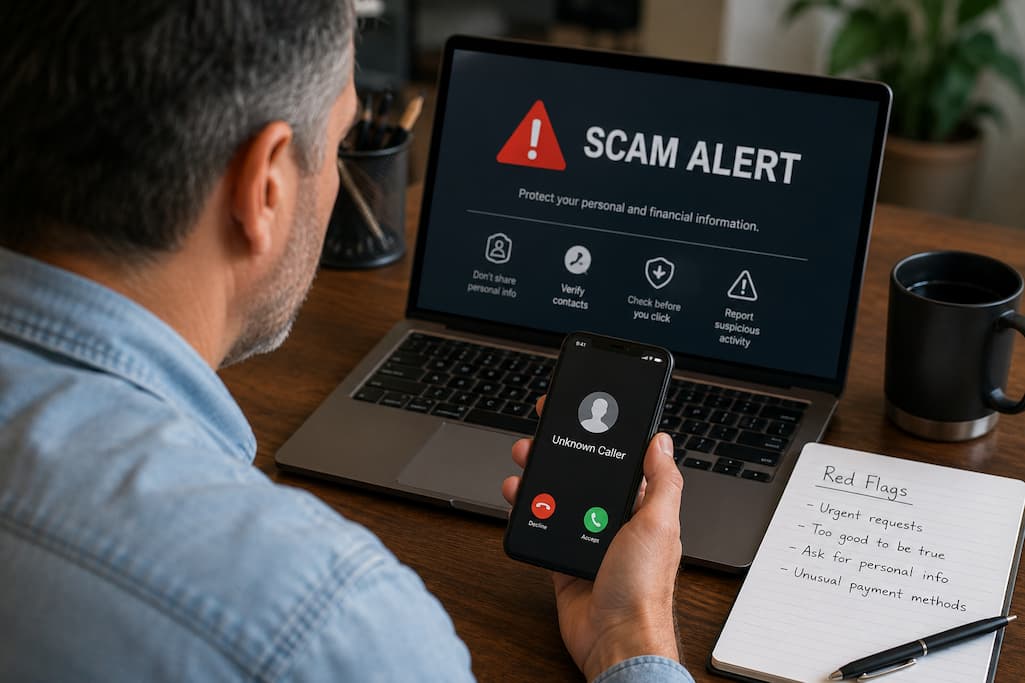

In 2024, consumers reported losing $10 billion to fraud. That is not a typo. Ten billion dollars. The Federal Trade Commission received 2.6 million fraud reports, and the median individual loss was $500. The most disturbing part? The majority of victims were not naive or careless. They were simply busy, stressed, and caught at the wrong moment by professionals whose entire job is separating people from their money.
Financial scams have evolved far beyond the Nigerian prince emails of the early 2000s. Modern scams are sophisticated, personalized, and engineered to exploit specific psychological triggers. They arrive via text, phone call, social media, job boards, and even dating apps. Understanding how they work is not paranoia. It is basic financial self-defense.
This article breaks down the most common scams operating right now, the specific red flags that expose them, and the concrete steps you can take before, during, and after an encounter. No fear-mongering. Just recognition patterns and response protocols.
The Anatomy of a Modern Scam
Every successful scam follows a predictable structure. It does not matter whether the target is a retiree in Florida or a software engineer in Seattle. The mechanics are the same because human psychology is the same.
Step one: The hook. The scammer creates a scenario that demands immediate attention. Your bank account is compromised. Your Social Security number is suspended. You won a lottery you do not remember entering. A family member is in jail and needs bail money. The hook works because it triggers fear, greed, or love — emotions that override rational thinking.
Step two: The urgency trap. You must act now. The offer expires in one hour. The police are on their way. The account will be frozen by midnight. Urgency prevents you from verifying facts, consulting others, or thinking critically. It is the single most important tool in every scammer’s kit.
Step three: The isolation play. Do not tell anyone. This is between us. Your family would not understand. The scammer knows that a second opinion usually kills the deal. Isolation ensures you make decisions alone, under pressure, without external reality checks.
Step four: The payment method. Wire transfer. Gift cards. Cryptocurrency. Cash sent by courier. These methods are irreversible, untraceable, and often impossible to recover. Legitimate organizations do not demand payment in gift cards. Ever.
If anyone — a government agency, a tech support representative, a love interest, a utility company — asks you to pay with gift cards, iTunes cards, Google Play cards, or Bitcoin ATMs, you are being scammed. No exceptions. No legitimate entity operates this way. Write this down and tape it to your computer monitor.
Scam Category One: Impersonation Fraud
The scammer pretends to be someone you trust or someone with authority. This category accounts for the largest share of reported losses.
Government Impersonation
The caller claims to be from the IRS, Social Security Administration, FBI, or local police. They threaten arrest, deportation, or license suspension unless you pay immediately. The caller ID may even spoof the actual government phone number.
Why it works: Most people have a reflexive fear of government authority. The threat of arrest triggers panic. Panic overrides logic.
The reality: The IRS does not call you. They send letters. The Social Security Administration does not suspend numbers over the phone. No government agency accepts gift cards or wire transfers as payment. If you owe taxes, you will receive multiple mailed notices before any enforcement action.
Tech Support Scams
A pop-up on your computer warns of a virus. A phone call claims to be from Microsoft, Apple, or your internet provider. The “technician” needs remote access to fix the problem. Once inside your computer, they install actual malware, steal passwords, or charge hundreds for fake services.
Why it works: Most people do not understand how their devices work. A confident voice using technical jargon sounds authoritative. The pop-up looks official.
The reality: Microsoft and Apple do not monitor your computer for viruses. They do not call you. Legitimate antivirus software does not display phone numbers in pop-up warnings. If you did not initiate the contact, hang up.
Family Emergency Scams
The call comes in the middle of the night. Your grandchild is in jail. Your nephew had a car accident. They need bail money or medical fees immediately. They beg you not to tell their parents. The voice sounds right, maybe because the scammer used AI voice cloning from a social media clip.
Why it works: Love and fear for family members bypasses skepticism. The request for secrecy prevents the victim from calling the actual relative.
The reality: Always verify through a known phone number. Call your grandchild directly. Call their parents. If the story is real, it will survive five minutes of verification. If the caller pressures you not to check, the story is fake.
The Verification Protocol
Before sending money to anyone claiming urgency, do three things:
1. Hang up and call back on a known, published number — not the one they provided.
2. Contact a trusted third party — spouse, friend, financial advisor — and describe the situation out loud.
3. Wait 24 hours. Real emergencies have real solutions that do not evaporate overnight.
Scammers hate all three of these steps. That is how you know they work.
Scam Category Two: Investment and Romance Fraud
These scams play on different emotions but use the same structural playbook. The goal is to build trust over time, then extract money.
Romance Scams
The relationship develops online — dating apps, social media, gaming platforms. The person is attentive, emotionally available, and often claims to be overseas for work (military, oil rig, international aid). After weeks or months of building connection, an emergency arises. They need money for a plane ticket, a medical procedure, or to clear customs on a package.
Why it works: Loneliness is a powerful motivator. The scammer invests significant time in the relationship. The victim feels understood and valued, often for the first time in years.
The reality: No one you have never met in person needs your money for an emergency. Video calls can be faked with deepfake technology. Reverse image search their photos. If they refuse to video chat or always have an excuse, you are talking to a script, not a person.
Investment Scams
Cryptocurrency schemes. Forex trading “opportunities.” Real estate flipping programs. The common thread: guaranteed returns with little or no risk. The pitch comes from a friend, a social media influencer, or a “financial advisor” who contacted you unsolicited.
Why it works: Greed and social proof. If your friend made money, maybe you can too. The returns seem modest at first — just enough to build credibility before the big ask.
The reality: Guaranteed returns above Treasury bond rates do not exist. If an investment promises 20% annual returns with no risk, the only guarantee is that you will lose money. Legitimate investments have prospectuses, registered advisors, and regulatory oversight. Ask for the SEC registration number. Scammers disappear at this question.
The Too-Good-To-Be-True Calculator
If someone promises to double your money in six months, run the math. To double $10,000 in six months requires a 100% annualized return. Warren Buffett averages 20% annually over decades. If this person could consistently generate 100% returns, they would be managing billions for institutional investors, not recruiting strangers on Facebook. The math does not lie. People do.
Scam Category Three: Employment and Payment Fraud
These target people actively looking for income — students, recent graduates, the unemployed, gig workers.
Fake Job Offers
You receive an offer for remote work with excellent pay and minimal requirements. Before you start, you need to pay for training materials, background checks, or equipment. The check they send you to cover these costs bounces after you have already sent money to their “vendor.”
Red flags: You never interviewed. The job pays far above market rate for the described work. They contact you from a Gmail or Yahoo address instead of a company domain. They ask for payment before you earn anything.
Overpayment Scams
You sell something online. The buyer sends a check for more than the asking price — “by mistake” — and asks you to refund the difference. Their check is fake. Your refund is real. You lose both the item and the overpayment.
Red flags: Any overpayment is suspicious. Legitimate buyers do not accidentally send $2,000 for a $500 item. They do not pressure you to refund quickly before their check clears. Real checks take days to clear; scammers demand immediate action.
Fake Check Scams
You are hired as a “mystery shopper” or “payment processor.” Your first task: deposit a check, keep a portion as your fee, and wire the rest to a third party. The check is counterfeit. When it bounces, the bank reverses the deposit and you owe the full amount.
The critical detail: Banks make funds available before a check fully clears. Availability is not verification. A check can bounce weeks after you have already spent or wired the money.
The Check Clearing Reality
Federal law requires banks to make deposited funds available within one to five business days depending on the amount. But the check itself may take two weeks to actually clear through the banking system. If you spend or wire money during that window, you are personally liable when the check bounces. Wait 10 business days before treating any deposited check as confirmed money.
Scam Category Four: Phishing and Identity Theft
These do not ask for money directly. They steal information that enables future fraud.
Email and Text Phishing
A message appears to be from your bank, Amazon, Netflix, or the postal service. It claims a problem with your account, a failed delivery, or suspicious activity. Click the link to verify. The link leads to a fake login page that harvests your username, password, and sometimes credit card details.
Recognition tactics: Hover over links before clicking. The visible text may say “amazon.com” but the actual URL is “amaz0n-security-update.ru.” Check for spelling errors, generic greetings (“Dear Customer” instead of your name), and threats of immediate account closure.
Smishing (SMS Phishing)
Text messages with malicious links are increasingly common because people trust texts more than emails. A message claims your package cannot be delivered, your bank detected fraud, or you won a prize. The link installs malware or leads to a credential-harvesting site.
Recognition tactics: Legitimate delivery services include tracking numbers you recognize. Banks do not send links in texts — they ask you to log in through their official app. When in doubt, open the official app or website directly, never through a link.
| Scam Type | Primary Emotion Exploited | Payment Method Demanded | Immediate Action |
|---|---|---|---|
| Government impersonation | Fear | Wire transfer, gift cards | Hang up. Call the agency directly. |
| Tech support | Fear, confusion | Credit card, remote access | Close the pop-up. Restart computer. |
| Romance | Love, loneliness | Wire transfer, gift cards | Cease contact. Report to platform. |
| Investment | Greed | Cryptocurrency, wire transfer | Verify SEC registration. Walk away. |
| Fake job | Hope, desperation | Upfront payment for “materials” | Never pay to start a job. |
| Phishing/Smishing | Urgency, curiosity | Stolen credentials, card data | Do not click links. Use official app. |
What to Do If You Have Been Scammed
Shame keeps most victims silent. Silence helps scammers. If you sent money or information, act immediately.
If you paid by credit or debit card: Contact your bank or card issuer immediately. Report the transaction as fraudulent. Request a chargeback. Time matters — most issuers have 60-day windows for disputes.
If you paid by wire transfer: Contact the wire transfer company (Western Union, MoneyGram, your bank) immediately. Ask if the transfer can be recalled. Success rates are low but not zero, especially if caught within hours.
If you paid by gift card: Contact the gift card issuer immediately. Some can freeze the card balance if the scammer has not spent it yet. Report to the FTC at ReportFraud.ftc.gov.
If you provided personal information: Place a fraud alert with one of the three credit bureaus (they notify the others). Consider a credit freeze, which blocks new accounts from being opened in your name. File an identity theft report at IdentityTheft.gov.
If you provided remote access to your computer: Disconnect from the internet immediately. Run a full antivirus scan. Change all passwords from a different, clean device. Consider wiping and reinstalling your operating system if you suspect malware.
The Reporting Chain
1. Your bank or card issuer — for financial recovery
2. FTC at ReportFraud.ftc.gov — for federal tracking and pattern analysis
3. FBI’s IC3.gov — for internet-facilitated crimes
4. Local police — for documentation, especially if identity theft is involved
5. The platform where contact originated — social media, dating app, job board — to prevent the scammer from targeting others
Reporting does not guarantee recovery. But it creates data that helps law enforcement identify patterns, shut down networks, and warn future victims.
Prevention: Building Your Personal Defense System
Scams succeed because they are unexpected. A prepared mind recognizes the pattern before the trap closes.
Freeze your credit. All three bureaus offer free credit freezes. A freeze prevents new accounts from being opened in your name. Thaw it temporarily when you legitimately need credit. It takes five minutes online and provides more protection than any paid monitoring service.
Use unique passwords and two-factor authentication. A password manager generates and stores complex passwords. Two-factor authentication means even if your password is stolen, a second code is required. Enable it on every financial account, email, and social media platform.
Set up account alerts. Most banks and credit cards offer text or email alerts for transactions, password changes, and login attempts from new devices. Enable all of them. The thirty seconds it takes to verify a legitimate alert is worth avoiding hours of fraud cleanup.
Verify independently. If someone claims to be from your bank, hang up and call the number on the back of your card. If they claim to be from the IRS, visit IRS.gov directly. If they claim a family member is in trouble, call that family member on a known number. Independent verification is the single most effective scam prevention tool.
The Five-Second Rule
Before acting on any unexpected financial request — phone call, email, text, pop-up — pause for five seconds. Ask yourself: Does this make sense? Would this organization actually contact me this way? What would happen if I waited an hour before responding?
Five seconds is enough to break the urgency spell. Most scams collapse under the weight of a single deliberate pause.
Related Articles
- How to Build Credit From Scratch Without a Credit Card — If identity theft damaged your credit, this guide covers alternative rebuilding methods.
- What Is a Credit Score and How It Is Calculated — Understand how fraud and identity theft affect the five factors that determine your score.
- How to Read Your Credit Report and Fix Errors — If a scam opened accounts in your name, this guide walks through disputing fraudulent entries.
- How to Save Money When Your Income Is Low — Financial stress makes people vulnerable to scams. These strategies reduce that pressure.
Sources and References
- Federal Trade Commission. “Consumer Sentinel Network Data Book 2024.” FTC.gov
- Federal Bureau of Investigation. “Internet Crime Report 2024.” IC3.gov
- Federal Trade Commission. “How to Avoid a Scam.” Consumer.FTC.gov
- Consumer Financial Protection Bureau. “What Is a Credit Freeze?” ConsumerFinance.gov
- Internal Revenue Service. “IRS Warns of Tax Scams.” IRS.gov

Ethan Walker is a personal finance writer who focuses on helping beginners understand money simply and practically. He writes about budgeting, saving money, financial literacy, and side hustles with the goal of making financial education easier and more approachable. His content is designed to help readers build better financial habits and make smarter everyday money decisions.