
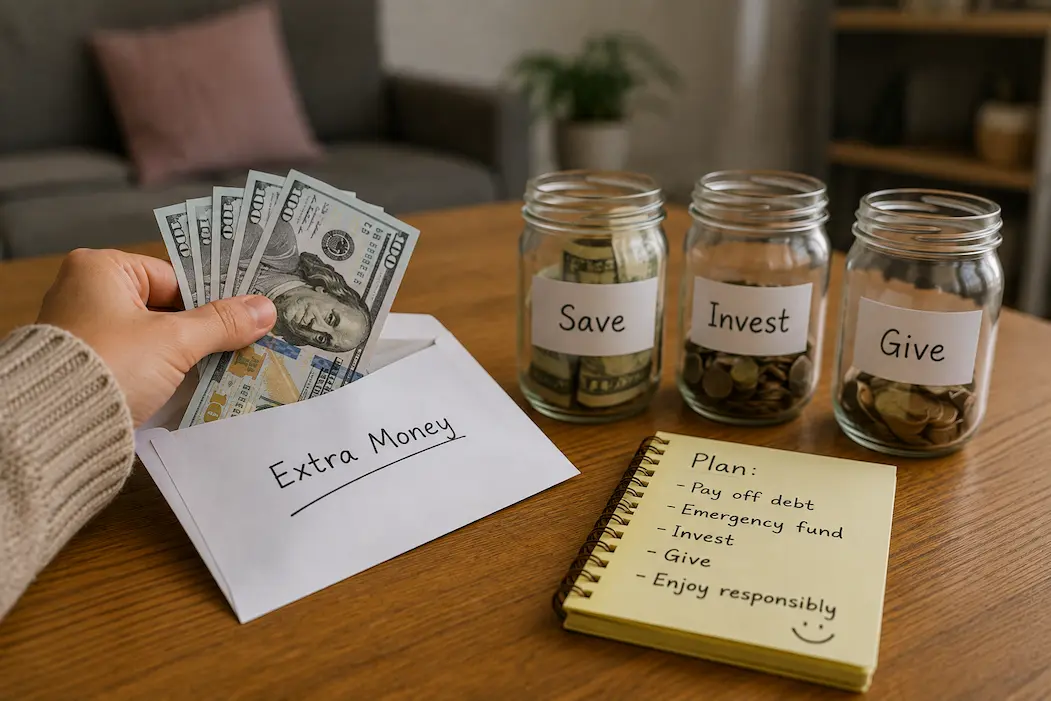

Extra money can feel very different from regular income. When a normal paycheck arrives, most of it already has a job: housing, food, transportation, bills, savings, and other planned expenses. A windfall or unexpected amount of money can feel less restricted because it was not part of the original monthly budget. That can make it surprisingly easy to spend the entire amount before deciding what it could have done for your financial situation.
Extra money can come from many places. It might be a work bonus, a tax refund, a cash gift, a freelance payment, a commission, money from selling something, an unusually strong month of income, or a reimbursement that was larger than expected. These amounts do not necessarily need to be treated in exactly the same way, because their size, reliability, and purpose can differ. The useful habit is to pause before spending and give the money a deliberate role.
The goal is not to avoid enjoying unexpected money. A financial plan that leaves no room for enjoyment can become difficult to maintain. Instead, the goal is to divide extra money intentionally so that some can improve your financial position, some can cover genuine upcoming needs, and some can be enjoyed without creating regret afterward.
First, Decide Whether the Money Is Truly Extra
Before deciding what to do with a larger-than-usual payment, determine whether you actually have unrestricted money available. Sometimes an amount appears to be extra because it is sitting in your account, even though part of it is already needed for something else. A reimbursement, for example, may be replacing money you previously spent. A freelance payment may need to cover business expenses or taxes depending on your circumstances. A bonus may arrive at the same time as an annual bill that was already approaching.
This is why the first step should be separating unexpected money from unassigned money. Ask what the payment represents, whether any part of it has an existing obligation attached to it, and whether another expense is likely to arrive soon. If you spend the entire amount simply because the balance temporarily looks larger, you may later have to use credit or withdraw from savings to cover something that was predictable. A short pause can prevent that problem. Let the money sit long enough for you to understand what it is before making major spending decisions.
Create a Temporary Holding Period
You do not need to make a complicated financial plan the moment money arrives. If the amount is significant enough to affect your budget, consider placing it somewhere separate from your everyday spending balance while you decide what to do. The purpose is not to make the money inaccessible forever. It simply creates enough distance to prevent the psychological effect of seeing a larger account balance from turning into immediate spending.
For example, imagine receiving an unexpected €1,000. If it remains mixed with your normal spending money, you may gradually use it for restaurants, shopping, entertainment, or other purchases without ever consciously deciding to spend €1,000. If you temporarily separate the amount, the decision becomes much clearer: you now have €1,000 that needs an intentional purpose. That small change in visibility can make a major difference because you are deciding how to allocate a defined amount rather than discovering later that it disappeared through dozens of unrelated purchases.
Give the Money More Than One Job
One reason windfalls disappear quickly is that people often approach them with an all-or-nothing mindset. They either spend the entire amount or try to save every euro and feel deprived. Neither approach is necessary. A better method is to divide the money among several priorities based on your current circumstances.
For example, a person receiving €1,200 might decide that part should strengthen savings, another part should cover an upcoming expense, and a smaller portion can be used for something enjoyable. The exact percentages do not need to follow a universal formula. Someone carrying expensive debt may have a different priority from someone who already has a strong cash reserve and is saving for a planned purchase.
The important principle is that the money receives its assignments before it gets absorbed into everyday spending. Once the amount has been divided deliberately, you can enjoy the portion intended for enjoyment without wondering whether you should have saved everything.
A Simple Allocation Example
Suppose you receive an unexpected €1,500 and have already confirmed that it is genuinely available after accounting for any related obligations. One possible allocation could look like this:
| Purpose | Amount | Reason |
|---|---|---|
| Savings goal | €600 | Increase progress toward a planned objective. |
| Financial cushion | €400 | Strengthen available reserves. |
| Upcoming expense | €300 | Reduce pressure from a known future cost. |
| Enjoyment | €200 | Spend without exceeding the planned amount. |
| Total | €1,500 |
This is only an illustration, not a recommended universal split. Your own allocation should reflect your financial position. The useful idea is that an unexpected payment can support several priorities at once rather than becoming one large shopping budget.
Use Windfalls to Strengthen Weak Points
Extra money is particularly useful when it addresses a financial weakness that would otherwise continue creating pressure. If your savings are thin, a windfall can increase your financial cushion. If a known annual expense is approaching, the money can reduce the amount you will need to find from a future paycheck. If you have an outstanding balance with a high borrowing cost, directing some of the money toward it may reduce future interest expenses, depending on the terms.
This does not mean every windfall should automatically go toward the most serious financial problem. It means you should look at your current situation before deciding how much of the money is available for discretionary spending. An extra €500 can feel like spending money when viewed in isolation, but it can also represent an opportunity to solve a problem that has been repeatedly competing with your monthly budget.
A useful question is, “What financial problem would become easier if I used part of this money now?” The answer may reveal a better use for at least some of the windfall.
Put Some Extra Money Toward Known Future Expenses
Not every financial priority is an emergency. Some expenses are predictable but irregular, which means they can create pressure when they arrive if you have not prepared for them. Examples include insurance renewals, vehicle maintenance, school-related costs, annual memberships, seasonal travel, gifts, home repairs, or other expenses that do not occur every month. A windfall can be useful for getting ahead of one of these costs.
Imagine that you know a €600 annual expense will arrive several months from now. Using part of an unexpected payment to prepare for it can reduce the chance that the future bill will interfere with your regular savings plan. The money is not necessarily increasing your long-term savings balance, but it is improving the stability of your overall financial system.
This distinction is important. Financial progress is not measured only by the balance of one savings account. Reducing future pressure can also make it easier to maintain good financial habits.
Avoid Increasing Your Regular Lifestyle Because of One-Time Money
One of the biggest risks with windfalls is turning temporary extra income into permanent expenses. Suppose you receive a one-time bonus and use it to upgrade your phone plan, increase your entertainment subscriptions, start a more expensive membership, and begin ordering more frequently. The bonus may cover the initial purchases, but the new recurring expenses remain after the money is gone.
This is sometimes called lifestyle inflation, but the important issue is simple: one-time money should be treated carefully before it becomes the reason for permanent commitments. A larger purchase can be reasonable if you have considered its ongoing costs, but recurring expenses deserve more scrutiny than a one-off purchase because they affect future months.
Before using a windfall to upgrade your lifestyle, ask whether you would still be comfortable paying for the new expense from your normal income six months from now. If the answer is uncertain, enjoying a smaller one-time portion may be safer than creating a permanent financial commitment.
Use a Windfall to Accelerate an Existing Goal
Extra money can be especially powerful when it is connected to a goal you have already established. Instead of inventing a new spending category, you can use the windfall to shorten the distance to something you already planned to achieve.
For example, suppose you are saving for a €3,000 purchase and have accumulated €1,400. Receiving an additional €500 would take the balance to €1,900, leaving a much smaller amount to fund through future savings. The windfall has not magically created wealth, but it has reduced the time required to reach a goal.
This approach can also make saving feel more rewarding because the effect is visible. You can see how an unexpected payment changed the timeline rather than allowing it to disappear into general spending. The same principle can apply to several types of goals. You might use extra money to strengthen a reserve, increase progress toward a planned purchase, or reduce another financial obligation. What matters is connecting the money to a defined objective.
Be Careful With Money You Receive Regularly
Not all “extra” income is genuinely unexpected. Some people receive irregular freelance payments, commissions, overtime, seasonal income, or recurring bonuses that vary in size. When this happens regularly, treating every payment as a windfall can make budgeting harder.
If a source of extra income becomes reasonably predictable, it may deserve its own planning approach. You can establish a conservative baseline from your reliable income and then decide in advance how additional earnings will be handled. For example, you might reserve part of variable income for irregular expenses and savings while allowing another portion to remain flexible.
The key is not to build fixed monthly commitments around the highest amount you have ever received. Variable income can change, so permanent expenses should generally be supported by income you can reasonably expect to continue.
Give Yourself Permission to Enjoy Some of It
Saving every unexpected euro may look financially disciplined, but it can also create an unrealistic relationship with money. If every bonus, gift, or unexpected payment immediately disappears into a savings account, you may eventually feel that financial responsibility means never enjoying your income.
Allowing a defined portion for enjoyment can make the overall approach more sustainable. The amount depends entirely on your circumstances. Someone dealing with significant financial pressure may reasonably allocate very little to discretionary spending, while someone with strong savings and manageable obligations may have more flexibility.
The important difference is between planned enjoyment and uncontrolled spending. If you decide beforehand that €150 of a €1,000 windfall is available for something enjoyable, spending that €150 is not a failure. It is part of the plan. You are enjoying the money while still protecting the other priorities you chose.
Think About the Future Version of the Money
Before spending a large portion of unexpected money, imagine what the same amount could accomplish if it remained available several months from now. This does not mean assuming a specific investment return or promising that saving will produce a particular financial outcome. It simply means comparing the immediate satisfaction of spending with the future usefulness of keeping the money available.
For example, €300 spent impulsively may produce a few enjoyable purchases that are quickly forgotten. The same €300 could contribute meaningfully toward a planned purchase, help cover an upcoming expense, or increase the amount of money available for an unexpected problem. Neither choice is automatically right or wrong. The value comes from making the choice consciously.
A short waiting period can help separate what you genuinely want from what simply feels attractive because you suddenly have more money available.
Create a Windfall Rule Before the Next One Arrives
It is easier to make a thoughtful decision about unexpected money when you have already decided how you generally want to handle it. You do not need a rigid formula, but having a basic rule prevents the excitement of receiving money from making the entire decision for you.
Your rule could be as simple as: first check whether any part of the money has an existing obligation, then reserve an amount for an important financial priority, then decide what portion can be enjoyed. The exact order and amounts can change according to your circumstances.
For example:
1. Identify obligations. Determine whether any portion of the money already has a purpose.
2. Review your financial priorities. Consider savings, upcoming expenses, debt, or other needs.
3. Allocate deliberately. Decide where each portion will go before spending.
4. Keep enjoyment intentional. Set aside a defined amount if your circumstances allow.
5. Avoid permanent commitments without planning. Be cautious about turning one-time income into recurring expenses.
Having this framework ready means you do not have to reinvent your financial decision every time an unexpected payment appears.
When Saving the Entire Windfall May Make Sense
There are situations where keeping most or all of an unexpected payment may be appropriate. If you have little financial cushion, a major expense approaching, or a particularly uncertain income situation, retaining the money can provide useful flexibility.
The same may be true when the payment is large relative to your normal income. A substantial windfall deserves more careful consideration than a small unexpected amount because using it impulsively can have a much larger long-term effect.
This does not mean you should automatically put every large payment into savings. It means the larger the financial impact, the more valuable it becomes to pause and assess the full situation before making irreversible spending decisions. A few days of consideration can be worthwhile when the alternative is spending a large amount and later wishing you had divided it differently.
A Practical Windfall Checklist
When unexpected money arrives, run through this checklist before spending it:
- Confirm where the money came from and whether it has any existing obligation attached to it.
- Check upcoming expenses that could otherwise compete with your monthly budget.
- Review your current savings and financial priorities.
- Decide whether any outstanding debt deserves consideration.
- Separate the amount from everyday spending if that helps you think clearly.
- Choose a specific amount or percentage for your main financial priority.
- Decide whether a portion can reasonably be used for something enjoyable.
- Avoid creating new recurring expenses simply because you received a one-time payment.
- Record what you decided so you can evaluate the result later.
The checklist does not tell you exactly where the money must go. Its purpose is to slow down automatic spending and make the decision intentional.
Conclusion
Extra cash and windfalls can enhance your financial condition, but only if you give them a purpose before you spend them on ordinary expenses. The first and most useful step is to just stop. Make sure the money is really there. Determine if you have any upcoming commitments or fees. Then decide how much should go to savings, financial priorities, future expenses, and fair enjoyment.
There is no set percentage that you should preserve from a bonus, rebate, gift, or other unexpected payment. Your choice should be based on your income stability, savings, future expenses, debt commitments, and financial objectives. What might work for someone who has a large pile of cash may not work for someone who is already feeling the pinch financially.
The point is to allocate intentionally. Don’t let more money turn into an inadvertent rise in your everyday expenditure—use it to fortify something that’s important to you. Save some, plan for future expenses, take care of a real financial need, and—when you can—enjoy some guilt-free. That balance can help transform an unexpected bill into meaningful financial momentum instead of a transient rise in spending.
FAQs
1. What if I get a surprise payment?
Not always. Should you save all of a windfall, most of it, or just some of it? It is contingent upon your financial situation and the nature of the money. If you have urgent financial demands or small reserves, then conserving a bigger chunk can be reasonable. If you are financially secure, it’s also reasonable to set aside some money for planned fun.
2. How to Split a Bonus the Best Way?
Everyone is different. First find out if any of it is already being used for taxes, expenses, reimbursements, or other responsibilities. Then think about your savings goals, expected expenses, debt, and discretionary preferences before selecting how much to allocate to each.
3. Should I put additional money into savings or pay down debt?
That depends on the type of debt you have, the cost of it, your current savings, and your overall financial picture. Some will benefit from paying off expensive debt, while others may want to have a certain amount of liquid cash to cover unforeseen expenses initially. Don’t assume that one priority is always more important than the other.
4. What if I get extra money on a regular basis?
If the income becomes relatively predictable, think of it as variable income, not a pure windfall. Do not raise your fixed expenses based on the biggest sums that you may get occasionally. Instead, build a prudent strategy for how any new income will be allocated between savings, future expenses, financial priorities, and discretionary spending.

Ethan Walker is a personal finance writer who focuses on helping beginners understand money simply and practically. He writes about budgeting, saving money, financial literacy, and side hustles with the goal of making financial education easier and more approachable. His content is designed to help readers build better financial habits and make smarter everyday money decisions.