
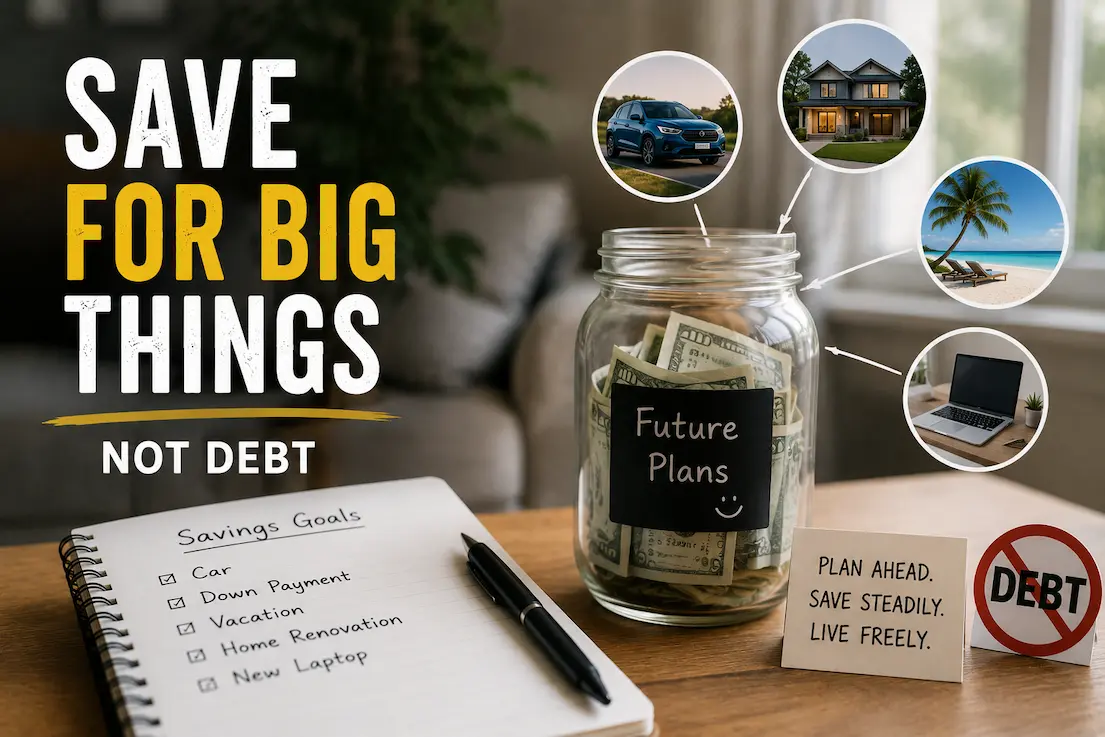

Large purchases can put pressure on a monthly budget even when the item is something you genuinely need. A car repair, replacement appliance, new computer, furniture, education expense, or family trip can cost several months of disposable income at once. When the money is not already available, borrowing can seem like the easiest solution because it allows the purchase to happen immediately. The problem is that financing can turn a single purchase into a longer financial obligation through interest, fees, and monthly payments. Saving ahead does not make every large purchase affordable, but it gives you more control over when you buy, how much you spend, and whether borrowing is actually necessary. A sensible approach starts by identifying the purchase, estimating its real cost, setting a timeframe, and building the required amount into your normal budget.
First Decide Whether the Purchase Needs to Happen Now
Before you set a savings goal, ask yourself if you truly need to make this purchase, if it’s reasonably time-sensitive, or if you just want it. That is important since a purchase that can wait provides you a chance to sort out your finances. You may have to make a quicker decision about replacing a damaged refrigerator than upgrading a working television. Equally, replacing hazardous tires is not the same as purchasing a modern car because you like the features. The idea is not to deem every purchase frivolous. It is to see if the schedule is flexible enough to make saving part of the decision.
Ask yourself what would happen if you waited a few months to buy it. If you create a safety hazard, can’t work, or cause another expense to dramatically increase by delaying it, saving for a lengthy period may not be realistic. But if the purchase is voluntary or can properly be deferred, you may have more choices by waiting. You can find that you need a cheaper version, locate a better deal, or recognize that the purchase isn’t quite as vital as you originally thought.
A Simple Timing Test
Before adding a large purchase to your savings plan, consider:
- Need: What problem does the purchase solve?
- Timing: Does it have to happen now?
- Condition: Can the existing item safely continue being used?
- Cost: What is the full amount likely to be required?
- Alternatives: Could repairing, renting, buying used, or choosing a simpler option work?
- Budget impact: Would paying for it now interfere with essential expenses or existing financial priorities?
This short assessment can prevent the common mistake of treating every large purchase as an emergency simply because it feels important at the moment.
Calculate the Real Cost Before You Start Saving
The price displayed on a product or service is not always the amount you will ultimately need. A vehicle may involve registration, insurance, maintenance, and other costs. A new appliance may require delivery or installation. A computer purchase may also involve accessories, software, or replacement equipment. Even a vacation can involve transportation, meals, fees, and other expenses beyond the advertised package price.
Write down the costs you reasonably expect before setting your savings target. Avoid padding the estimate with every imaginable expense, but do leave some room when the final price is uncertain. If you set a target that is too low, you may reach your goal and discover that you still need to borrow to cover the difference.
| Purchase | Main cost | Possible additional costs | Savings target |
|---|---|---|---|
| Laptop | $1,000 | Accessories and software | $1,150 |
| Appliance | $900 | Delivery and installation | $1,050 |
| Used car | $12,000 | Registration and initial maintenance | $13,000 |
| Family trip | $2,500 | Meals, transport, and activities | $2,900 |
These figures are examples rather than universal estimates. The actual amount should come from the purchase you are considering. The important lesson is that the savings target should reflect the expected total cost, not just the headline price.
Turn the Total Cost Into a Monthly Target
Once you have a realistic target, choose the date by which you would like to make the purchase. Then calculate how much you need to set aside during the available period. For example, suppose you want to spend $1,800 on a replacement appliance and related costs. If you have 12 months before you expect to buy it:
$1,800 ÷ 12 = $150 per month
A $150 monthly target gives you a concrete figure to test against your existing budget. If $150 is affordable without creating problems, you can afford the purchase. However, this amount reveals your financial reality before you commit, which may mean you need a loan. You can reconsider the purchase date, reduce the target cost, increase the amount saved, or combine several approaches.
For example, extending the timeframe to 18 months would change the calculation:
$1,800 ÷ 18 = $100 per month
The purchase has not become cheaper. You have simply given your budget more time to prepare for it.
What If the Monthly Amount Is Too High?
If the required monthly savings amount does not fit your budget, test these possibilities:
- Extend the timeframe if the purchase can safely wait.
- Reduce the purchase cost by considering a less expensive model or alternative.
- Increase available savings by redirecting money from a temporary expense.
- Use existing non-emergency savings if that money was already intended for the purchase.
- Reconsider the purchase if it would put too much pressure on your finances.
This is an important decision point. A savings calculation is useful not because it guarantees you can afford the purchase, but because it reveals the financial reality before you commit.
Keep Large-Purchase Savings Separate From Emergency Money
One of the easiest ways to create a financial problem is to use emergency savings for a planned purchase and then discover that an actual emergency occurs afterward. Money saved for a new vehicle, holiday, furniture, or electronics should therefore be distinguishable from money reserved for unexpected financial shocks.
The separation does not necessarily require multiple bank accounts. You can use separate savings accounts if your bank provides them or track different goals within a single account. What matters is that you know which money is committed to the planned purchase and which money should remain available for emergencies. A large balance in one account can create a false sense of how much money is actually available to spend.
Think of Your Savings as Having Different Jobs
A simple organization might look like this:
| Savings purpose | Intended use | Should it fund a planned purchase? |
|---|---|---|
| Emergency reserve | Unexpected essential expenses | Generally no |
| Large-purchase fund | Known future purchase | Yes. |
| Annual expense fund | Predictable irregular costs | Only for those expenses |
| General savings | Flexible financial goals | Depends on your priorities |
The categories can be adjusted to suit your situation. The point is to avoid treating every dollar sitting in savings as interchangeable.
Choose a Place for the Money That Supports the Goal
The account you use for a large purchase should make it reasonably easy to add money while reducing the temptation to spend it casually. A separate savings account can help because it keeps the balance separate from the money used for everyday purchases. Some people also find it helpful to give the account a clear purpose, such as “Car Replacement” or “New Appliance.”
The right place for the money depends partly on the timeframe. Money needed relatively soon generally calls for an approach that prioritizes accessibility and preservation of principal rather than taking substantial investment risk. A short-term purchase goal is different from retirement or another long-term objective. The closer you are to needing the money, the less practical it usually is to rely on an asset whose value could fall significantly at the wrong time.
Automate the Contribution When It Fits Your Budget
A planned transfer can make large purchases easier because you do not have to remember to move money every month. If your target is $150 and you receive income on a predictable schedule, you might divide the contribution across your pay periods. For example, you could make two $75 transfers to reach the same monthly target as one $150 transfer.
Automation should still be monitored. If your income changes, an important bill increases, or another financial priority becomes urgent, the transfer may need to be adjusted. The purpose of automation is to support the plan, not to lock you into a payment that no longer fits your circumstances.
Use Extra Money to Shorten the Timeline
You do not have to fund a large purchase entirely through the same monthly transfer. If you receive a bonus, refund, gift, or other extra money, you can decide whether some of it should accelerate the purchase goal. The decision should be based on your broader financial position rather than an assumption that every unexpected dollar must immediately go toward the purchase.
For example, someone saving $150 per month for an $1,800 purchase would normally reach the target in 12 months. If they receive an additional $300 and choose to put it toward the goal, the remaining amount becomes $1,500. At the same monthly rate, they could then reach the target sooner. Alternatively, the person could keep the original timeline and reduce the monthly contribution. The useful part of this approach is flexibility. Extra money can change the timing of a purchase without requiring a permanent change to the household budget.
Do Not Ignore Price Changes While You Are Saving
A savings target can become outdated. Prices may rise, a model may be discontinued, installation costs may change, or the item you eventually choose may cost more than the original estimate. Review the target periodically rather than assuming the first number you calculated will remain accurate for a year or more.
At the same time, avoid constantly raising the target just because you keep finding more expensive versions of the item. If you originally planned to spend $1,500 on a functional appliance and later convince yourself that you need a $2,500 premium model, the problem may not be inflation. The purchase itself may have changed. Keeping the original purpose in view helps distinguish a necessary adjustment from lifestyle inflation.
Compare Saving First With Financing the Purchase
Sometimes borrowing can be reasonable. A purchase may be urgent, the financing terms may be favorable, or waiting may create a larger financial loss. The mistake is assuming that financing is automatically better simply because the monthly payment looks manageable.
When comparing options, look beyond the monthly payment. Consider:
- Total amount paid
- Interest charges
- Fees
- Length of the repayment period
- Whether the rate can change
- Early repayment conditions
- What happens if you miss a payment
- Whether the payment would restrict your future budget
A Simple Financing Comparison
Suppose a purchase costs $2,000. Paying $2,000 from money already saved is straightforward, as long as it does not compromise essential reserves. A financing option might instead divide the purchase into monthly payments, but the total amount repaid could be higher once interest and fees are included.
The key question is not simply “Can I afford the monthly payment?”
A better question is
“What will this purchase actually cost me, and what other financial commitments will this payment create?”
That question helps reveal why a low monthly payment can still represent an expensive purchase.
Avoid Using Debt Just to Reach the Goal Faster
The whole purpose of saving for a large purchase is to reduce the pressure to borrow when the purchase date arrives. If you repeatedly put ordinary spending on a credit card, use buy-now-pay-later financing, or take out loans to preserve your savings balance, the savings plan is not solving the underlying problem.
This does not mean that every form of borrowing is irresponsible. Credit can have legitimate uses, particularly when an expense is urgent or when a carefully evaluated financing arrangement makes sense. The important distinction is between planned financing that fits the overall financial picture and borrowing simply because the savings goal was uncomfortable to wait for. If you are consistently tempted to borrow before reaching your target, revisit the purchase price and timeline. The original target may have been unrealistic.
Know When Paying in Cash Is Not the Best Choice
Saving before a purchase is a useful strategy, but it should not become an absolute rule. Some situations justify considering other options. For example, a necessary expense may arrive before you have had enough time to save, or a financing arrangement may have terms that are reasonable compared with the alternatives available to you.
The decision should also account for what happens to your remaining cash after the purchase. Paying cash for a $10,000 purchase may technically avoid interest, but if it leaves you with no emergency reserve and no money for upcoming essential expenses, the decision deserves more thought. Financial safety involves more than avoiding interest charges.
A practical decision can therefore involve three questions:
Can I afford the purchase?
Can I afford it without damaging my financial reserves?
Is borrowing genuinely useful in this situation, or am I using it because I would rather not wait?
Those questions are more useful than treating either cash or credit as automatically superior.
A Large-Purchase Savings Checklist
Before committing to a major purchase, work through this checklist:
- Identify whether the purchase is necessary, flexible, or optional.
- Decide whether the purchase can safely be delayed.
- Estimate the complete cost rather than only the advertised price.
- Set a realistic target date.
- Calculate the required monthly contribution.
- Check whether that amount fits your existing budget.
- Keep planned-purchase money separate from emergency reserves.
- Review the target as prices or circumstances change.
- Consider using suitable extra income to accelerate the goal.
- Compare the total cost of financing rather than only the monthly payment.
- If the required savings target remains consistently unaffordable, please reconsider the purchase.
This process does not guarantee that every purchase can be made without debt. It gives you a clearer picture of what the purchase requires before you commit to it.
What If You Need the Purchase Before You Can Save Enough?
Waiting is not always an option. A car can break down, the refrigerator might break down, and there are tools you need for work. Then the goal changes from “don’t borrow” to minimizing the financial harm when a necessary purchase must be made.
Start by identifying the lowest possible solution. A good secondhand appliance can cure the problem without having to go for the most expensive replacement. A fix may allow an item to remain viable long enough to build up the necessary savings. If you have to borrow, assess various solutions by total cost and repayment conditions, not just the lowest advertised monthly payment. If you can, keep up the savings habit after the purchase. The next goal is to recoup the money that was spent or to develop a replacement fund for the next big spend. A big purchase doesn’t have to break your savings system; it may show you the benefit of having one.
Saving First Means More Options
Saving for a big purchase isn’t all about avoiding all forms of debt. “It’s about being able to make the decision, not being forced into the first financing option that appears. Get the real cost, choose a reasonable date, and break the amount into bite-sized payments, and you’ll know if the buy really matches your budget before you go for it.
It also helps you determine when a transaction should be postponed, scaled back, or tackled differently. If you can meet the monthly target, regular saving can change a significant expense from a financial shock into a planned event. If the objective is not manageable, finding out early provides you a chance to adjust the plan before interest costs and monthly payments become part of your budget. The idea isn’t to stop borrowing altogether but to make big-ticket purchases on purpose, understanding exactly what they’ll cost you and how they’ll influence your finances down the road.
FAQs
1. When do I start saving for a big purchase?
No set time frame. Begin by estimating the entire amount you will require, then calculate how much your present budget can allocate on a monthly basis. The more expensive the purchase, the less your monthly surplus, and the longer you may need. The earlier you start, the more flexible you are. You can get there by making little monthly payments rather than a huge payment at the end.
2. Should I utilize my emergency savings for a scheduled purchase?
Funds designated for true emergencies should not be the default funding source for foreseeable expenditures. If you know you will need a new appliance, vehicle, or other significant item, setting up a separate savings goal will assist in protecting your emergency reserve. If you have to make a sudden urgent purchase, however, the right choice depends on your household’s full financial picture.
3. Is it better to save or use a loan for a large purchase?
It is contingent upon how urgent the purchase is, the cost of financing, how many funds you have to spare, and the impact on your overall budget. If you need to make a purchase that you cannot reasonably defer, borrowing may be appropriate. Saving first can decrease interest and monthly commitments. Compare the whole financial cost and the effect on your reserves rather than focus solely on the monthly payment.
4. What if I don’t save enough each month for the buy?
Try first to push the date of purchase further into the future. Then reassess the total cost and consider whether a cheaper option would meet your needs. If the aim remains unreasonable, that information is useful: it may suggest the item is currently outside your budget. Recognizing it before going on debt is one of the key benefits of assessing the funds requirement in advance.

Ethan Walker is a personal finance writer who focuses on helping beginners understand money simply and practically. He writes about budgeting, saving money, financial literacy, and side hustles with the goal of making financial education easier and more approachable. His content is designed to help readers build better financial habits and make smarter everyday money decisions.