
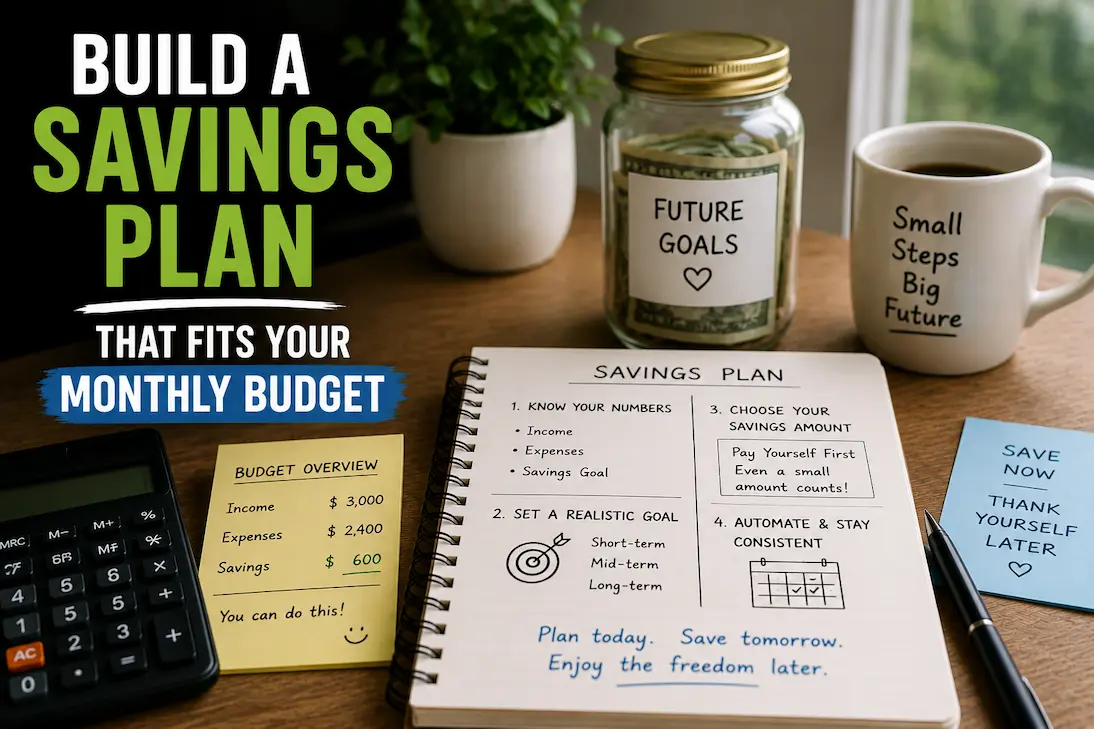

It is much easier to stick to a savings plan if the amount you want to save aligns with your budget. A savings goal that looks perfect on paper can quickly become frustrating if you lack the funds to cover bills, groceries, transportation, or other unexpected expenses. The aim of a savings plan isn’t to make your income and expenses balance perfectly every month. Instead, you need to map out a clear path for your money while leaving room for daily expenses. Don’t start your plan with a percentage you *think* you can afford; start with an amount you *know* you can afford. Once you understand your income, daily expenses, cost fluctuations, and financial priorities, you can set a sustainable savings goal that can be adjusted if necessary.
What Your Monthly Budget Can Support
Before setting a savings goal, you need to figure out your household’s monthly income and how much is already allocated to essential expenses. When planning to save, start with your net income rather than your average salary, because you can only save the money you actually have left over. List all your reliable sources of income, but exclude bonuses, overtime pay, commissions, or other one-off payments from your fixed income. Next, list your monthly expenses—such as rent, bills, groceries, transport, insurance premiums, debt repayments, subscriptions, and other daily costs. The goal isn’t to create a complex spreadsheet but simply to calculate how much money remains after paying for all your daily expenses.
A simple starting calculation is
Take-home income − essential expenses − regular discretionary spending − planned irregular expenses = available amount
That final amount should not automatically become your savings target. Some of it may need to remain available as a cushion because real budgets rarely behave exactly as expected. A car repair, higher utility bill, school expense, or medical cost can change a month’s numbers without warning. If you save every dollar that appears to be available, you may end up transferring money back out of savings whenever something unexpected happens. A better plan allows for some flexibility and prioritizes sustainability over maximizing the transfer in any single month.
Example: A Savings Target That Leaves Room to Breathe
Imagine someone brings home $3,000 per month. After housing, utilities, groceries, transportation, insurance, debt payments, and normal discretionary spending, they estimate that about $450 remains. Instead of automatically saving the entire $450, they might initially choose a $300 monthly savings target and leave $150 as a flexible cushion. IfIf several months pass without needing the cushion, they can later transfer part of that extra money to savings.his approach may appear slower, but it reduces the chance that the person will have to undo the savings transfer after an unusually expensive month.
| Monthly budget item | Example amount |
|---|---|
| Take-home income | $3,000 |
| Essential and regular expenses | $2,250 |
| Amount remaining | $750 |
| Planned savings transfer | $300 |
| Flexible monthly cushion | $450 |
The numbers are only an example, not a recommended budget percentage. Another household with the same income could have completely unique housing costs, debt obligations, family responsibilities, or transportation expenses. That is why a useful savings plan should be based on the person’s own cash flow rather than a rule that assumes every household has the same financial situation.
Separate Essential Costs From Flexible Spending
One reason savings plans fail is that people treat every expense as equally fixed. Some expenses are difficult to change in the short term, while others can move up or down depending on choices made during the month. Housing payments, insurance premiums, minimum debt payments, and certain utility costs may have limited flexibility. Groceries, entertainment, eating out, shopping, subscriptions, and other discretionary categories often provide more room for adjustment. Separating these categories helps you understand whether your savings target is genuinely affordable or whether it depends on cutting spending that you are unlikely to reduce consistently.
This does not mean that every flexible expense needs to be eliminated. A savings plan that removes everything enjoyable can become difficult to maintain and may encourage people to abandon it after a few weeks. Instead, look for expenses where a modest adjustment would have a meaningful effect. If reducing one subscription saves $15 a month but makes little difference to the overall budget, while changing an expensive recurring habit could free up $100, the second category deserves more attention. The point is to identify trade-offs consciously rather than treating saving as a punishment for spending money.
Account for Expenses That Do Not Happen Every Month
A monthly budget can look healthy when it only includes bills that arrive every four weeks. The problem appears when an annual insurance payment, vehicle maintenance bill, holiday spending, school expense, or home repair suddenly arrives. These expenses may be irregular, but they are not necessarily unexpected. If you know that certain costs occur during the year, they should have a place in your savings plan before they become urgent.
Suppose you expect $1,200 of irregular expenses over the next year. Instead of waiting for each expense, you could divide that amount across the months you expect to incur it. Saving $100 per month toward those known costs does not necessarily represent long-term savings, because you will eventually spend that money. However, it prevents those expenses from competing with your emergency fund or forcing you to use credit when the bill arrives. This distinction is important: money set aside for a known future expense is different from money being accumulated for long-term savings.
Use Separate Buckets for Different Purposes
You do not necessarily need a separate bank account for every financial goal. The important part is knowing what each portion of your savings is intended to do. Depending on your situation, you might organize your money around categories such as
- Emergency savings for genuine unexpected needs
- Planned annual or irregular expenses
- A specific large purchase
- Short-term personal goals
- Longer-term financial goals
The organization method can be as simple as separate accounts, labeled savings spaces where available, or a written record showing how much of your balance belongs to each goal. The best system is the one you can understand and maintain without constantly moving money around.
Choose a Savings Amount You Can Repeat
Once you understand your budget, choose a starting savings amount that you could reasonably repeat during ordinary months. Consistency is usually more valuable than choosing an ambitious number that works only when nothing goes wrong. If $250 feels comfortable while $500 requires constant sacrifices, starting at $250 may give you a better foundation. You can always increase the amount later when your income rises, an expense disappears, or you discover that your original target was more conservative than necessary.
A useful way to test your target is to ask what would happen if the next month were slightly pricier than usual. If just one moderately higher grocery bill or utility payment would force you to cancel the savings transfer, your target may be too aggressive. On the other hand, if you can handle normal fluctuations while still making the transfer, you probably have a more sustainable starting point. Your first target does not have to be your permanent target. It simply needs to work well enough to establish a repeatable system.
A Simple Three-Level Savings Target
For people who are unsure what number to choose, it can help to create three levels rather than one rigid target.
| Target level | Purpose |
|---|---|
| Minimum | An amount you can usually save even during a difficult month |
| Standard | Your normal monthly savings target |
| Extra | Additional money saved during unusually strong months |
For example, a person might decide that $100 is the minimum, $250 is the normal target, and anything above that is an opportunity to save extra. This creates flexibility without turning saving into an all-or-nothing decision. A month in which you save $100 is not automatically considered a failure simply because you could not reach $250.
Match the Plan to the Goal
The amount you save makes more sense when you know what the money is intended to accomplish. Saving without a purpose can make it difficult to decide whether you are making enough progress. A goal gives you a target and a timeframe, which makes the monthly calculation much more practical.
For example, if you want to accumulate $1,200 for a planned purchase over 12 months, a simple starting calculation would be
$1,200 ÷ 12 months = $100 per month
If you already have $300 set aside for that goal, the remaining amount is $900:
$900 ÷ 12 months = $75 per month
This calculation does not guarantee that the purchase will remain exactly $1,200 or that your budget will remain unchanged. Prices can change, priorities can shift, and unexpected expenses can interrupt the plan. The value of the calculation is that it turns a vague goal into a measurable monthly commitment that can be reviewed as circumstances change.
Decide Where the Savings Transfer Should Happen
Once the amount is chosen, decide how the money will move into savings. Some people prefer transferring money shortly after receiving their paycheck so the intended savings amount is separated before discretionary spending takes place. Others prefer reviewing their budget first and transferring money after essential expenses have been covered. Neither approach is automatically better for everyone.
Automatic transfers can make saving easier because they reduce the number of decisions required each month. However, automation should not mean ignoring the account balance. If income changes or an unusually large bill arrives, an automatic transfer that was affordable several months ago may no longer be appropriate. A savings system should be convenient while still leaving you aware of what is happening in your accounts.
Review the Plan Instead of Abandoning It
A savings plan should be reviewed periodically because household finances change. Rent can increase, a loan can be paid off, income can change, or a new recurring expense can appear. Reviewing the plan does not mean rebuilding the entire budget every week. A monthly or quarterly check can be enough for many people to see whether the target still fits their circumstances.
During a review, look at three things: whether the planned savings transfer was affordable, whether important expenses were higher or lower than expected, and whether the savings goal itself has changed. If the plan consistently leaves too much unused money in the checking account, you might need to increase the savings target. If the transfer repeatedly has to be reversed, the target may need to be reduced. The review aims to improve accuracy, not to judge your past month.
When Your Income Changes
A temporary decline in income does not automatically mean the entire savings strategy has failed. You can temporarily reduce the transfer, pause savings for a specific goal, or focus on protecting emergency reserves until cash flow improves. Likewise, an increase in income does not require immediately increasing every financial commitment. Some of the additional money could be directed toward savings while the rest supports other priorities.
This flexibility is especially important for households with variable earnings. A fixed savings amount may work well when income is stable but become unrealistic when monthly earnings fluctuate. In that situation, a minimum-plus-percentage approach can be useful: establish a modest amount that can normally be saved and then direct a portion of unusually strong months toward the goal. The exact percentage should depend on the household’s circumstances rather than being treated as a universal rule.
Avoid Turning Savings Into a Competition With Yourself
It is all too common to become focused on reaching a particular savings number and forget why the money is being saved. A larger balance is useful, but not if reaching it requires missed bills, new credit card debt, or repeatedly withdrawing the money to cover normal expenses. The purpose of a savings plan is to improve financial resilience and help fund future priorities, not to create a number that looks impressive in a bank account.
It is also useful to compare your current progress with your own previous position rather than with someone else’s savings balance. A person paying high housing costs and supporting a family may have an entirely different capacity to save than someone living with fewer financial obligations. A realistic plan that continues for years can be more valuable than an aggressive plan that lasts for six weeks.
A Practical Monthly Savings Planning Checklist
Before finalizing your savings plan, work through this checklist:
- Confirm your actual take-home income.
- List essential recurring expenses.
- Identify flexible spending categories.
- Estimate known irregular expenses.
- Decide which goals require dedicated savings.
- Choose a realistic minimum savings amount.
- Set a normal monthly target.
- Decide how savings will be transferred.
- Leave an appropriate cash-flow cushion.
- Review the plan regularly.
- Adjust the target when your circumstances change.
This checklist is intentionally simple. A savings plan does not need complicated financial software to work. What matters is that the amount you intend to save is visible, the purpose of the money is clear, and the plan reflects the way your household actually operates.
What If You Cannot Afford to Save Much Right Now?
A small savings amount can still be useful when the alternative is having no financial buffer at all. If your budget is extremely tight, the first objective may be creating a modest reserve rather than immediately trying to build a large long-term balance. Saving $20 or $50 consistently may not change your finances quickly, but it can create a small amount of flexibility that becomes valuable when an unexpected expense arises.
At the same time, saving should not be treated as more important than essential needs. If your income does not cover basic expenses, the solution may require reducing costs, increasing income, restructuring certain obligations, or seeking appropriate financial assistance rather than simply forcing a savings transfer. A sustainable savings plan is based on financial reality. It should help you move forward without pretending that every household has the same amount of money available after paying for necessities.
Build a Plan You Can Actually Keep
A good savings plan is not the one with the largest monthly transfer. It is the one that fits your budget closely enough that you can continue using it when an ordinary month becomes slightly pricier. Start with real take-home income, account for essential and flexible expenses, prepare for costs that do not arrive every month, and choose a savings target that leaves enough room for normal financial surprises. From there, give each major savings goal a clear purpose and review the plan as your circumstances change.
The most useful savings system is therefore less about finding a perfect percentage and more about creating a repeatable process. When the amount is realistic, the purpose is clear, and the plan can adapt, saving becomes part of the monthly budget rather than something that happens only when money is left over. That makes it easier to build financial reserves gradually while still keeping today’s essential expenses under control.
FAQs
1. How much should I save each month?
There is no single monthly amount that works for every household. The appropriate figure depends on income, essential expenses, debt obligations, existing savings, dependents, and financial goals. A useful starting amount is one that can normally be saved without causing you to fall behind on necessary bills or repeatedly withdraw the money afterward. You can increase the target when your financial situation improves.
2. Should I save before or after paying my bills?
Many people find it useful to move a planned amount into savings soon after receiving income, while others prefer to pay essential expenses first and then transfer what their budget allows. The better method is the one that consistently works without creating cash-flow problems. If automatic saving causes overdrafts or forces you to move money back, the transfer amount or timing should be adjusted.
3. What should I do if I miss my savings target?
Missing a target does not require abandoning the entire plan. First determine why the target was missed. If an unusual expense caused the problem, you may simply need to resume your normal transfer the following month. If the target is repeatedly unaffordable, reduce it to a level that better reflects your actual budget. A savings plan should be adjusted when the underlying numbers change.
4. Is money for annual expenses considered savings?
Money set aside for a future expense is still being saved in the everyday sense, but it serves a different purpose from money intended for emergencies or long-term goals. Separating these purposes can prevent you from treating money needed for an upcoming bill as if it were available for another goal. This distinction also makes it easier to understand your true financial progress.

Ethan Walker is a personal finance writer who focuses on helping beginners understand money simply and practically. He writes about budgeting, saving money, financial literacy, and side hustles with the goal of making financial education easier and more approachable. His content is designed to help readers build better financial habits and make smarter everyday money decisions.