
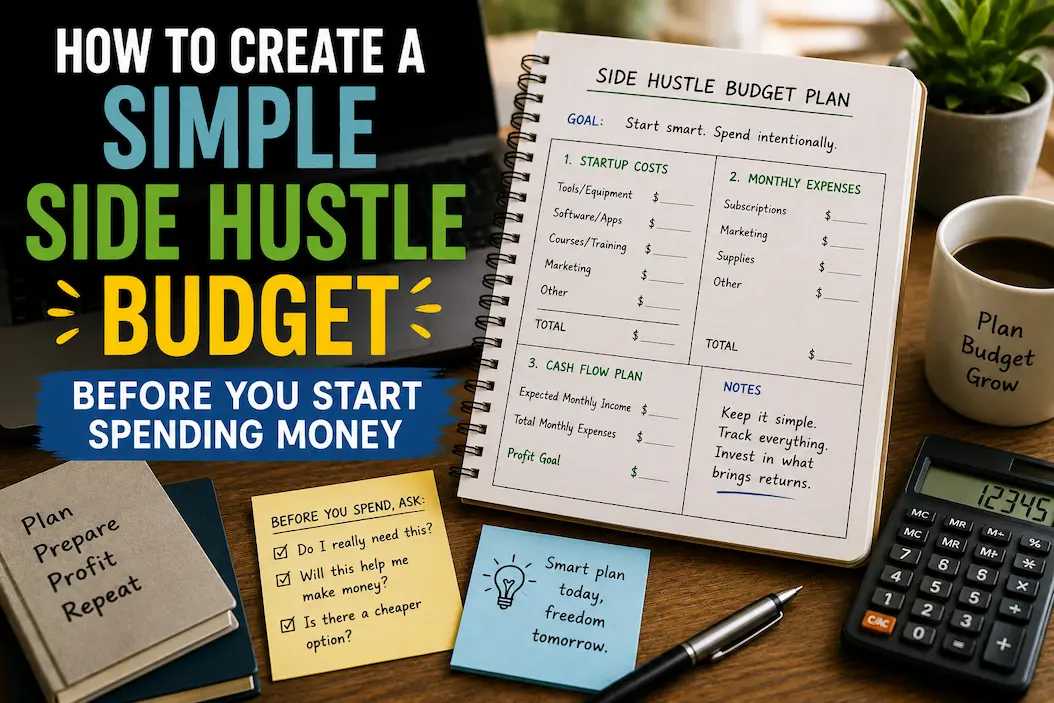

Starting a side hustle often begins with an exciting idea and a surprisingly long shopping list. A website needs hosting, a seller needs supplies, a freelancer may want software, and a service provider may think better equipment will make the business look more professional. The danger is spending money before you know whether the idea can realistically earn enough to justify those costs. A side hustle does not become profitable simply because you have invested in it.
A simple budget gives you a different starting point. Instead of asking what you could buy, you first decide what the side hustle actually needs, how much you can safely put into it, what expenses will continue after launch, and what results would justify spending more. The purpose is not to predict your future income perfectly. It is to put a reasonable limit around your financial risk while you test whether the idea works.
Start With the Amount You Can Actually Afford to Risk
Your side hustle budget shouldn’t start with predicted revenue. Before considering sales, assess how much personal money you can invest in the project. After considering household and financial priorities, this amount should come from available funds. If spending the money might interfere with rent, bills, emergency savings, debt payments, or other vital responsibilities, the side hustle budget is too aggressive.
This distinction matters since a new side gig is unknown. You may have a wonderful idea, but you can’t predict how quickly customers will arrive, if your price will work, or which expenses will be needed. Making startup money seem like a guaranteed investment can lead to irreversible expenditure. A safer approach is to assess what you can afford and seek evidence before increasing it. Starting with a small budget is useful. Sometimes a simple test can tell you more than a big launch. You can confirm demand using tools you already have, talents you already have, or affordable resources to see if consumers desire the product or service before investing a lot of money.
Separate One-time and Monthly Costs
By dividing spending by date, a side hustle budget is easy to understand. One-time purchases or setups are not expected to repeat. The long-term budget is more affected by recurring costs after the side gig starts. Basic equipment, inventory, domain registration, a tool, packing supplies, or professional setup are one-time expenses. Software, website hosting, advertising, storage, platform fees, insurance, and other recurring expenses may remain even if revenues are low. The side gig classifications vary, but the distinction is useful for most business ideas.
A $300 side gig that costs $20 per month is different from one that costs $100 to start but $150 per month. The second idea may seem cheaper due to a lower initial purchase, but its ongoing costs can add up. Considering both statistics prevents you from focusing solely on the initial price.
Make a Basic Cost List Before Buying
Before unlocking your wallet, list your needs. Avoid browsing and adding tempting items to a cart. Start with the task you want to do and work backward. Freelance services may involve a computer, internet, software, and a decent website. If you have a good computer and internet connection, you may not need additional equipment. A product-based side gig may need materials, packaging, storage, and shipping, although the first test batch may not need as much as an established enterprise. This activity often distinguishes obligatory, useful, and optional spending. That distinction can prevent a new side gig from taking money before it proves clients will pay.
Create Three Spending Categories
A practical beginner budget can use three categories: must-have costs, useful upgrades, and optional spending. This is deliberately simpler than trying to create a detailed accounting system before the side hustle has even made its first sale.
Must-have costs are expenses without which you cannot reasonably provide the product or service. Useful upgrades may improve efficiency, appearance, convenience, or quality but are not essential for testing the idea. Optional spending includes things that are nice to have but have little effect on whether the first customers can actually be served.
This approach creates a natural spending order. The essentials get considered first. Improvements come later if the activity starts producing evidence that they are worthwhile. Optional purchases can wait until there is a clear reason to make them. The exact items in each category will vary, but the principle remains the same: do not confuse a better setup with a necessary setup.
| Spending category | Question to ask |
|---|---|
| Must-have | Can I realistically operate without this? |
| Useful | Will this noticeably improve the work or reduce a meaningful cost? |
| Optional | Would I still buy this if I had no customers yet? |
The last question can be surprisingly revealing. If you would not buy something before knowing whether the side hustle has demand, it may not belong in the initial budget.
Set a Startup Spending Ceiling
Once you have listed the expected costs, establish a maximum amount you are willing to spend during the testing phase. This ceiling should be decided before you start purchasing, because it is easier to increase spending when there is no predetermined limit.
Suppose you decide that your initial test budget is $300. You might allocate $180 to genuinely necessary setup costs, keep $70 available for expenses that become apparent after launch, and leave $50 uncommitted. The exact numbers are only illustrative; the important feature is that the entire $300 is not automatically treated as money that must be spent.
An unspent budget is not a failure. If you can test the idea successfully while spending less than your ceiling, that is useful information. It means you have preserved more of your personal cash while learning whether the side hustle has potential.
Do Not Spend the Whole Budget Just Because It Exists
A budget is a limit, not a target. This is an important distinction when starting something new because people often feel that unused money should be put to work. That can lead to unnecessary equipment purchases, oversized inventory orders, expensive branding, or subscriptions that do not yet have a clear purpose. Instead, think of the spending ceiling as permission to spend up to a certain amount when the expense has a legitimate reason. If the reason does not exist, keep the money. You can always spend later when the side hustle provides evidence that the purchase is justified.
Estimate Your Break-Even Point
You do not need a complicated financial model to understand whether a side hustle has a reasonable path toward recovering its costs. A simple break-even calculation can help. If you spend $240 on startup and early operating costs and earn $40 of profit from each completed sale after the costs directly associated with that sale, you would need six such sales to recover your initial spending of $240.
$240 ÷ $40 = 6 sales
This is an illustrative calculation, not a prediction of what any particular side hustle will earn. The important point is that break-even analysis connects spending with the amount of profitable activity required to recover it. Without that connection, a $240 purchase can feel small even if the side hustle has very little realistic opportunity to generate enough profit to cover it.
Break-even thinking is particularly useful for larger purchases. Before spending $800 on equipment, for example, ask how many additional jobs or sales the equipment would need to help generate before the cost is recovered. If the answer depends on an unrealistic volume of business, waiting may be more sensible.
Budget for the Cost of Making Each Sale
Some side hustles have expenses that increase whenever you make a sale or complete a job. These are important because they affect the profit left from each transaction. A product seller may have material, packaging, payment processing, marketplace, or shipping costs. A local service provider may have fuel, supplies, or other job-specific expenses. A digital service might involve transaction fees or software costs that increase with usage. The exact expenses depend on the business model.
When preparing a budget, estimate the cost associated with delivering one typical sale or job. This gives you a clearer picture of what the revenue actually means. Selling a product for $50 is not the same as earning $50 if $20 is required to fulfill that order. The amount available to cover overhead and eventually become profit is smaller.
Include Recurring Costs Even Before They Become Large
Subscriptions deserve special attention because each one can appear inexpensive in isolation. A $10 monthly tool may not seem important, but several subscriptions can turn into a meaningful fixed cost before the side hustle has generated consistent revenue.
For every recurring expense, ask what problem it solves and whether you need it immediately. If the answer is unclear, delay it. Some tools offer free versions, pay-as-you-go options, trial periods, or manual alternatives that may be sufficient during the testing stage. That does not mean free tools are always better; it means recurring expenses should have a clear purpose before becoming part of the business’s monthly obligations.
You should also consider how easy the expense is to cancel. A service that can be stopped easily may present less ongoing commitment than one involving a contract or significant upfront payment. Understanding the terms before subscribing is part of budgeting, not an administrative detail to deal with later.
Give Yourself a Small Contingency Amount
Even a carefully prepared budget will miss something. A supplier may charge more than expected, an item may need replacing, or an expense you did not anticipate may appear once the side hustle becomes operational. Leaving the entire budget allocated to known purchases gives you no flexibility when that happens.
A contingency amount is simply money deliberately left uncommitted for reasonable surprises. It does not have to be large, and there is no universal percentage that everyone should use. The right amount depends on cost uncertainty and how much you can comfortably risk. The important part is to keep the contingency separate from optional spending. If you treat the reserve as extra shopping money, it will probably disappear before an actual unexpected cost occurs. A contingency exists to protect the budget from reasonable surprises, not to encourage additional purchases.
Decide How You Will Judge the First Test
A side hustle budget becomes much more useful when you establish what you are trying to learn from the initial spending. Otherwise, you can keep spending simply because you have not yet decided whether the experiment is successful.
Your first test might be designed to determine whether customers will pay, whether a product can be delivered at a workable cost, whether you can complete the work within a reasonable amount of time, or whether a particular sales channel produces enough demand to justify its fees. The goal does not have to be immediate profit. The goal is to collect enough useful information to make the next financial decision more intelligently.
For example, a person testing a service might set a limit of $200 for initial setup and promotion. Instead of assuming that spending the full amount will produce a certain number of customers, they can decide beforehand that the test will be reviewed after a defined period or number of inquiries. The result could be encouraging, disappointing, or inconclusive. Each outcome provides different information for the next decision.
Track Spending From the First Day
A simple spreadsheet or note can be enough to record the date, expense, category, amount, and reason for each purchase. You do not need sophisticated accounting software to understand where your startup money is going.
The benefit of tracking is that memory tends to make spending feel smaller than it actually was. A few purchases made over several days may not seem significant individually, but the total can quickly exceed the amount you originally intended to invest. Recording each expense gives you a running total and makes it harder to accidentally drift beyond your budget.
Keep records of revenue and business expenses as the side hustle develops as well. Depending on your location and circumstances, those records may become important for tax reporting or other financial purposes. For U.S. side hustlers, tax treatment can depend on the nature of the activity and individual circumstances, so maintaining organized records from the beginning can make later decisions easier.
Know When a Purchase Has Earned Its Place
After the side hustle starts operating, new purchases should be evaluated based on evidence rather than excitement. An expense becomes easier to justify when you can identify a specific problem it solves and a reasonable way it could improve the economics of the activity.
For example, buying a tool may make sense if the current process takes several hours and the new tool can reliably reduce that workload. Purchasing additional inventory may make sense when existing inventory is selling and you have enough evidence to believe more stock can be used without creating an unnecessary cash commitment.
The key is not to demand that every purchase produce an immediate measurable return. Some expenses provide convenience, reliability, or quality improvements that are difficult to quantify precisely. The goal is simply to ask whether the expense is proportionate to the current size and evidence behind the side hustle.
Avoid Using Debt to Make the Budget Look Bigger
Credit can make a startup budget appear larger than the amount you can actually afford. That can be particularly risky when the side hustle has not yet demonstrated reliable demand. Borrowing to purchase equipment, inventory, advertising, or subscriptions creates an obligation that remains even if the side hustle generates less income than expected.
That does not mean every form of business financing is automatically inappropriate. Established businesses sometimes use financing for specific purposes based on predictable cash flow and carefully evaluated costs. A brand-new side hustle with uncertain revenue is a different situation.
For a beginner, the simplest test is often to ask whether the side hustle can be explored using money that is genuinely available rather than money that must be repaid. If the idea only works financially when you borrow to launch it, that is a reason to examine the business model more carefully before committing yourself to the expense.
Review the Budget After the First Results
Your initial budget is a starting point, not a permanent rule. Once the side hustle produces actual information, compare what happened with what you expected.
- Were your startup costs accurate?
- Did recurring expenses appear that you had overlooked?
- Did customers respond to the offer?
- Did the work take longer than expected?
- Did the revenue cover the costs associated with producing it?
These questions help you decide what should happen next. A side hustle that shows promising demand but has high fulfillment costs may need a pricing or sourcing change. One that generates little interest may need a different offer or audience rather than more advertising. Another may prove inexpensive to operate but require more time than expected.
The important point is that the next spending decision should be based on what you have learned. You should not automatically increase the budget simply because the first amount has already been spent.
A Simple Side Hustle Budget You Can Start With
For someone who wants a straightforward system, the initial budget can be organized into five lines:
| Budget item | What to include |
|---|---|
| Initial setup | Essential one-time purchases |
| First operating costs | Materials, fees, supplies, or other early expenses |
| Recurring costs | Subscriptions, hosting, insurance, or similar ongoing costs |
| Contingency | Money kept available for reasonable surprises |
| Unspent reserve | Money deliberately not committed yet |
The final category is worth keeping. You do not have to assign every dollar to a purchase simply because you have decided how much you are willing to invest. Keeping part of the money uncommitted gives you flexibility to respond to what actually happens after launch.
Over time, you can make the budget more detailed if the side hustle grows. At the beginning, however, clarity is generally more valuable than complexity. You want a system you will actually use rather than an elaborate spreadsheet that becomes another task you avoid.
The Best Side Hustle Budget Is One That Limits Bad Decisions
Startup budgets are not supposed to predict side hustle earnings. Its main function is controlling events before results are known. Setting an affordable spending ceiling, separating essential costs from optional upgrades, identifying recurring expenses, estimating break-even requirements, and leaving some money uncommitted lets you test an idea without committing to it.
The most crucial habit is letting evidence inspire expenditure. If customers start paying, prices are affordable, and the task fits into your timetable, you can review the budget and decide whether to invest more. If results are weak, the budget limited how much money you exposed before you noticed it.
A side hustle can establish its potential without an expensive launch. Smaller, more controlled experiments often provide better data while safeguarding your finances. Start with what’s necessary, measure what happens, then make the following expenditure decision after learning from the first.

Ethan Walker is a personal finance writer who focuses on helping beginners understand money simply and practically. He writes about budgeting, saving money, financial literacy, and side hustles with the goal of making financial education easier and more approachable. His content is designed to help readers build better financial habits and make smarter everyday money decisions.