
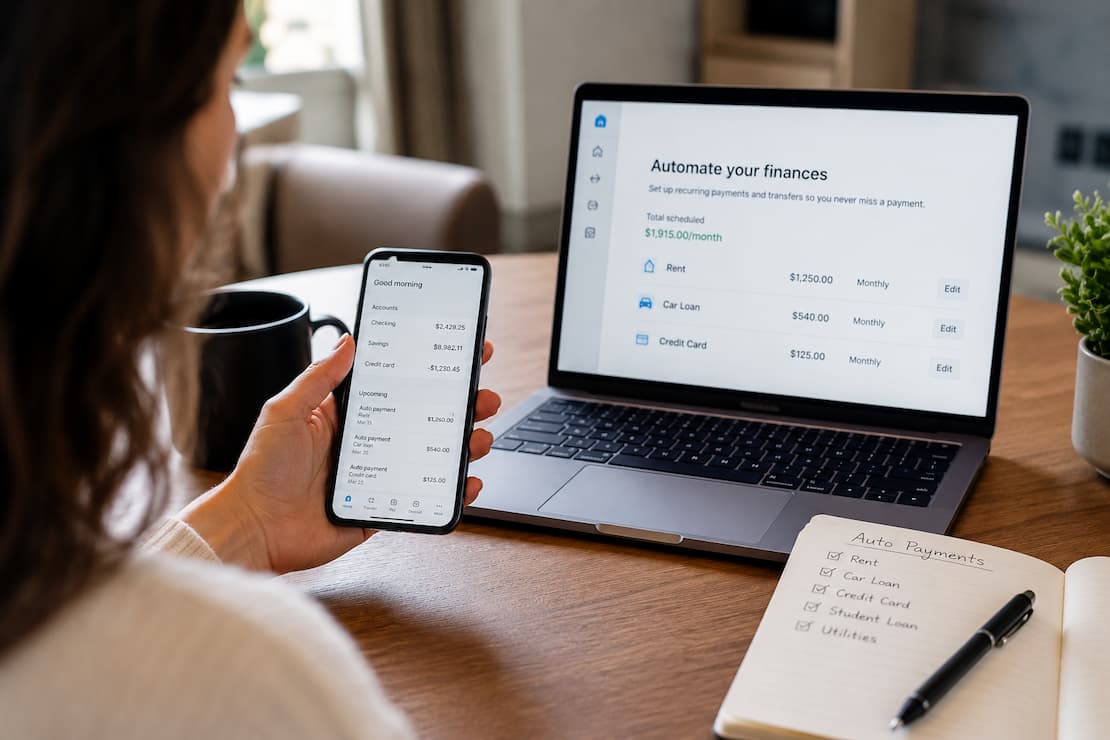

The average American pays $250 per year in late fees. Not interest. Not penalties for being broke. Just fees for forgetting. Forgetting to log into a portal. Forgetting a due date fell on a weekend. Forgetting that autopay expired when a credit card was replaced. Two hundred and fifty dollars, evaporated, because memory is unreliable and life is crowded.
Automation fixes this. Not partially. Not theoretically. Completely. When your financial obligations run on autopilot, you stop paying for forgetfulness. You stop scrambling at 11:47 PM on the 14th. You stop discovering disconnected utilities because a bill slipped your mind during a busy week. The system handles it. You handle everything else.
This is not about laziness. It is about removing friction from necessary tasks so your attention goes where it actually matters. The setup takes two hours. The payoff lasts decades. Here is exactly how to build it.
What Financial Automation Actually Means
Automation is the systematic transfer of recurring financial tasks from your memory to scheduled systems. Bills pay themselves. Savings transfer themselves. Investments buy themselves. Debt payments happen without your intervention. You become the architect, not the operator.
The concept is simple. The execution requires three layers working together: a central checking account that receives all income, automated outflows for obligations and goals, and guardrails that prevent overdrafts and catch errors before they cascade.
The Foundation Principle
Every automated system needs a single hub. One checking account where your paycheck lands and from which all automated payments flow. Multiple income accounts, multiple payment accounts, and manual transfers between them defeat the purpose. Consolidate first. Automate second.
Layer One: Automating Fixed Obligations
Fixed obligations are predictable, recurring expenses with consistent amounts. Rent. Mortgage. Car payment. Student loans. Insurance premiums. Subscription services. Gym memberships. These are the easiest to automate because the amount does not change.
The method depends on who controls the payment initiation.
Push automation: You set up automatic payments from your bank account to the recipient. You control the timing, the amount, and the account. Most banks offer online bill pay that sends physical checks or electronic transfers on scheduled dates. This is the safer option because you retain control.
Pull automation: The recipient pulls money from your account on a scheduled date. You provide your account number or card details and authorize them to charge you. Utility companies, insurance providers, and lenders typically prefer this method. The risk is that the recipient controls the timing and amount. Errors on their end can cause overdrafts or incorrect charges.
| Method | Who Controls Timing | Best For | Risk Level |
|---|---|---|---|
| Bank bill pay (push) | You | Rent, mortgage, irregular bills | Low |
| Autopay through provider (pull) | Provider | Utilities, insurance, loans | Medium |
| Credit card autopay | Card issuer | Recurring subscriptions | Low-Medium |
The Scheduling Trick
Set all automated payments to arrive three to five days before the actual due date. This buffer absorbs weekends, holidays, and processing delays. A payment scheduled for the 15th that arrives on the 12th is early. A payment scheduled for the 15th that processes on the 17th because of a weekend is late. Build the buffer. Pay for punctuality with time, not money.
Layer Two: Automating Variable Expenses
Variable expenses change month to month. Groceries. Gas. Dining out. Entertainment. These resist full automation because the amounts fluctuate. But partial automation is possible and valuable.
The envelope method, digitized: Create separate savings accounts labeled by category. Groceries. Dining. Entertainment. Transfer fixed amounts into each account automatically on payday. Spend only from the designated account. When the account is empty, spending in that category stops until the next transfer.
Most online banks allow unlimited savings accounts with no fees. Capital One 360, Ally, and Marcus by Goldman Sachs are popular options. The separation creates natural spending limits without requiring constant budgeting decisions.
The two-account system: Keep one checking account for fixed obligations and automated transfers. Keep a second checking account with a debit card for discretionary spending. Transfer a fixed amount to the discretionary account each payday. When it is gone, discretionary spending pauses. The fixed obligations account remains untouched and protected.
Why Two Checking Accounts Work
When rent, utilities, debt payments, and savings transfers all flow from one account, the remaining balance is your true discretionary amount. But most people see the full paycheck deposit and mentally allocate the entire amount. A second account creates a physical separation that prevents mental accounting errors. The money in Account A is spoken for. The money in Account B is yours to spend. No math required.
Layer Three: Automating Savings and Investments
This is where automation transforms financial outcomes. Consistent investing beats sporadic investing. Consistent saving beats heroic but irregular deposits. The system makes consistency automatic.
Emergency fund automation: Set a recurring transfer from checking to savings on payday. Even $50 per week becomes $2,600 per year. The key is timing the transfer for payday, before lifestyle inflation absorbs the money. Pay yourself first is not a slogan. It is a scheduling decision.
Retirement contribution automation: If your employer offers a 401(k), contributions come out of your paycheck automatically. Increase the percentage by 1% every six months until you reach your target. You will not feel the incremental decreases in take-home pay, but the compounding effect over decades is substantial.
Investment account automation: Brokerage accounts at Vanguard, Fidelity, Schwab, and others allow automatic investments into index funds. Schedule monthly purchases. The amount buys more shares when prices are low and fewer when prices are high. This is dollar-cost averaging, and it removes the emotional decision of when to invest.
The Percentage Method
Instead of fixed dollar amounts for savings and investments, use percentages of your paycheck. A 50/30/20 split — 50% to needs, 30% to wants, 20% to savings and debt — works for many people. But the automation magic happens when you flip the order: 20% to savings and investments transfers automatically on payday, then 50% to fixed obligations, then 30% remains for discretionary spending. The percentage ensures your savings grow with your income.
Layer Four: Automating Debt Elimination
Debt payments should be automated at the minimum level for all accounts, with additional automated payments directed toward the highest-interest debt. This ensures you never miss a payment — protecting your credit score — while systematically accelerating payoff.
The avalanche method, automated: List all debts by interest rate. Pay minimums automatically on everything. Direct all extra payment capacity toward the highest-rate debt. When that debt is eliminated, redirect the full payment amount to the next highest-rate debt. The payment amount snowballs as debts disappear.
The snowball method, automated: List all debts by balance. Pay minimums automatically on everything. Direct extra payments toward the smallest balance. When that debt is eliminated, redirect the payment to the next smallest. The psychological wins of closing accounts motivate continued progress.
Both methods work. Automation makes either method effortless. The critical step is setting the automated minimums first, then layering the accelerated payment on top.
The Guardrails: Preventing Automation Disasters
Automation is powerful but not foolproof. A forgotten expired credit card can cause a cascade of failed payments. An overdrawn account triggers fees that compound the original problem. Build guardrails before you need them.
Overdraft protection with a savings link: Link your primary checking account to a savings account. If a scheduled payment would overdraw, the bank transfers from savings automatically. Some banks charge a fee for this service. Others do not. Find one that does not. Ally and Schwab offer free overdraft transfers from linked accounts.
Low balance alerts: Set text or email alerts when your checking account drops below a threshold you define. $500 is a reasonable minimum for most people. The alert gives you time to transfer money or pause discretionary spending before automatic payments fail.
Annual automation audit: Once per year, review every automated payment, transfer, and investment. Verify amounts are still correct. Confirm payment methods have not expired. Check that recipients are still the right ones. A subscription you canceled six months ago might still be charging because the cancellation did not propagate to the payment system.
The Expired Card Cascade
In 2023, I replaced a credit card due to fraud. I updated Netflix, my gym, and my electric bill. I forgot my car insurance autopay. The payment failed. My insurance lapsed for 48 hours before I caught it. During those 48 hours, I drove to work. If I had been in an accident, I would have been uninsured. Update every autopay when cards expire. Keep a list. Check it twice.
When Automation Goes Wrong
Automation fails in predictable ways. Recognizing the patterns prevents panic and enables quick recovery.
Overdraft spiral: A large unexpected expense drains your account. Scheduled payments bounce. Overdraft fees accumulate. The solution: pause all non-essential automated payments immediately. Contact creditors to explain. Most will waive the first late fee if you have a history of on-time payments. Rebuild the cash buffer before reactivating automation.
Phantom subscriptions: A free trial converts to paid. A service you thought you canceled keeps charging. Annual subscriptions renew without reminder. The solution: review bank and credit card statements monthly. Use apps like Truebill (now Rocket Money) or simply scan statements for unfamiliar charges. Cancel aggressively.
Automation complacency: You set it up five years ago and never reviewed it. Your income increased but your savings percentage stayed flat. Your debt was paid off but the automated extra payment kept going to a closed account. The solution: calendar reminders for annual automation reviews. Treat it like a dental appointment — non-negotiable, scheduled, recurring.
Frequently Asked Questions
What if I do not have a steady paycheck?
Automation works for irregular income too, but requires a larger cash buffer. Maintain one month of expenses in checking as a floor. When income arrives, immediately transfer fixed amounts to savings, debt, and investment accounts. The timing shifts, but the structure remains.
Should I automate credit card payments?
Yes, but carefully. Set autopay for the full statement balance, not the minimum. This prevents interest charges. Keep a buffer in checking to cover the payment. If your checking balance is unpredictable, set autopay for the minimum as a safety net and manually pay the remainder when funds are available.
What about bills that vary each month?
Utilities, phone bills, and credit cards fluctuate. For utilities, many providers offer budget billing — an averaged monthly amount based on your usage history. This converts a variable bill into a fixed one, making automation easier. For credit cards, see the previous answer. For truly unpredictable bills, schedule calendar reminders three days before due dates and pay manually.
Can I automate if I live paycheck to paycheck?
Especially then. The discipline of paying yourself first — even $25 per paycheck — builds the habit before the amounts become significant. Automate minimum debt payments to protect your credit. Automate small savings transfers to build an emergency fund. As income grows, increase the automated amounts before lifestyle inflation absorbs them.
What is the best bank for automation?
Look for free online bill pay, unlimited savings accounts, free overdraft transfers, and robust alert systems. Ally, Capital One 360, Schwab, and Fidelity Cash Management score well on these criteria. Traditional banks often charge fees for services that online banks provide free. The $12 monthly maintenance fee at a brick-and-mortar bank is $144 per year you could be saving instead.
Related Articles
- How to Create a Simple Monthly Budget for Beginners — Automation works best when you know your numbers. This guide helps you establish the baseline.
- Understanding the 50/30/20 Rule With Practical Examples — The percentage framework that underlies effective automated savings and spending.
- How to Stay Consistent With Financial Habits — Automation is the ultimate consistency tool. This article explores the psychology behind why it works.
- How to Manage Money With Irregular Income — Automation for freelancers, gig workers, and anyone whose paycheck size changes month to month.
Sources and References
- Consumer Financial Protection Bureau. “Automating Your Savings.” ConsumerFinance.gov
- Federal Reserve. “Report on the Economic Well-Being of U.S. Households in 2024.” FederalReserve.gov
- National Foundation for Credit Counseling. “Financial Literacy Survey 2024.” NFCC.org
- Vanguard. “Dollar-Cost Averaging: A Technique for Consistent Investing.” Vanguard.com
- Ally Bank. “Automated Savings Tools.” Ally.com

Ethan Walker is a personal finance writer who focuses on helping beginners understand money simply and practically. He writes about budgeting, saving money, financial literacy, and side hustles with the goal of making financial education easier and more approachable. His content is designed to help readers build better financial habits and make smarter everyday money decisions.